At my official residence in Islamabad, I entertain my valued guests almost every day with my Japanese chef’s skilful cuisine. He prepares authentic Japanese dishes using local ingredients and sometimes arranges them with elements of Pakistani food. The chef’s handmade cakes and Pakistani fruits for dessert finish the course meal. Of course, this season, the stars are the mangoes, which have become even sweeter in July.
Japan started importing Pakistani mangoes in 2011. They have been gaining popularity in Japan, where they have been touted as the “sweetest mangoes in the world.” Quarantine inspectors from the Ministry of Agriculture, Forestry, and Fisheries visit Pakistan every year to check mango processing and packing facilities. Thanks to the efforts of producers, exporters, and distributors, Pakistani mangoes are enjoyed in Japanese households.
Behind Pakistan’s proud foodstuffs and products to the world is the private sector’s passion as the driving force. Japan has had business ties with this region for over 100 years since 1918, when Japan Cotton Trading Company (now Sojitz), which was responsible for exporting quality cotton to Japan, established an office in Karachi.
After the Second World War, Japan achieved economic growth thanks to Pakistan’s lifting of the ban on cotton exports to Japan. This year marks the 70th anniversary of Japan’s official development assistance (ODA) to Pakistan. In 1954, Japan’s ODA began when the predecessor organisation of the Japan International Cooperation Agency (JICA) welcomed a Pakistani trainee to Japan in the field of public administration.
‘Business is not a volunteer activity; companies cannot move forward unless it is feasible as a business’
The following year, eight Japanese experts in the field of agriculture were dispatched to Pakistan. Japan’s development cooperation began with technical cooperation in the form of people-to-people exchange, and this became the philosophy of Japan’s ODA. Over the past 70 years, a cumulative total of 7,443 Pakistanis have studied in Japan, and 3,140 Japanese experts have supported the government and the people of Pakistan.
Large-scale infrastructure projects such as the Kohat Tunnel, the Ghazi-Barotha hydroelectric power plant, the Indus Highway, and the East-West Road are also well-known examples of Japanese assistance. Behind these projects were people-to-people relationships based on trust.
Projects in which Japanese companies provided their technical expertise in cooperation with local construction companies not only contributed to the development of infrastructure for socioeconomic development but also had the effect of technology transfer.
In a wide range of fields such as education, health, water supply and sewerage, and disaster prevention, Japan has practiced self-help support by “teaching how to fish, rather than just giving fish.” Last year, Japan revised its Development Cooperation Charter, taking the concept of self-help support further and adopting the concept of “co-creation” as one of its basic policies, which means the creation of social values through dialogue and cooperation.
Human-centred cooperation is also evident in Grant Assistance for Grassroots Human Security Projects (GGP). Projects that quickly meet the needs of local communities, such as school construction, road and bridge rehabilitation, and providing hospital equipment, have been implemented in cooperation with local non-governmental organisations (NGOs).
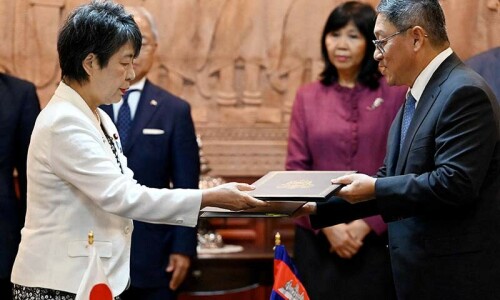
Collaboration with locally based organisations allows for cooperation that reflects the needs of each individual. Every year, I host signing ceremonies at my residence and go to the project site for the handover ceremonies. That is one of my favourite jobs as Japanese Ambassador; it allows me to get a sense of what the local people are thinking of.
We also provide support in cooperation with the United Nations and other international organisations. For the 2022 floods, for instance, Japan pledged about $77 million in assistance, half of which is being implemented in cooperation with international organisations.
We have also been supporting the Polio Eradication Programme in Pakistan through the United Nations Children’s Fund (Unicef) since 1996. This long-standing partnership has helped to reach millions of children with life-saving vaccines over the years. Cooperation at the private sector level should not be forgotten.
Currently, about 80 Japanese companies are doing business in Pakistan together with their Pakistani counterparts. In addition to contributing to tax revenues, the automotive industry has contributed to Pakistan’s socioeconomic development in terms of direct and indirect employment growth, technology transfer, employee moral education, and corporate social responsibility activities in the region.
Of course, business is not a volunteer activity. Companies cannot move forward unless it is feasible as a business. We are looking forward to the Pakistani government’s progress on the “Ease of Doing Business” policy. We are committed to further developing the relationship between Japan and Pakistan and looking for new business opportunities based on the more than 100 years of business relations.
Last year, Morinaga Milk increased its capital by $57m. Toyota invested $100m to begin local production of hybrid-electric vehicles. Kumon, a Japanese education company, opened classrooms in Islamabad, Lahore, and Karachi, aiming to open 15 classrooms by the end of next year.
In the information technology (IT) sector, Japan Station, which provides software offshore development services for Japan, is extending business. Human resource firms Plus W and Profound Vision have established offices in Pakistan and are helping Pakistani IT engineers to explore onshore and offshore job opportunities with Japanese companies.
When I visited Sialkot last year with representatives of Japanese companies, I learned that high-quality Japanese materials and machine tools support Sialkot’s internationally competitive products, such as soccer balls and medical equipment.
In the midst of a shortage of foreign currency, I have heard an easy argument that “exports are good, imports are bad,” but I was very proud to see that imports from Japan are supporting Pakistan’s export industries.
To support these efforts, the Pakistan-Japan Business Forum, in cooperation with its Japanese counterpart, the Japan-Pakistan Business Cooperation Committee, has been holding regular meetings and seminars, and arrangements are currently underway for the next meeting.
Besides business, there are other interactions between people. There are Japanese nurses in Multan who have been supporting local healthcare for many years. There are also Japanese NGOs working to support Pakistan.
The relationship between Japan and Pakistan has been strengthened and diversified by passionate Japanese and Pakistani people. An ambassador’s job is to empathise with, connect, encourage, and support people who have a passion to do their part for the relationship between Japan and Pakistan.
During my tenure in Pakistan for over two and a half years, I have met many passionate people. Each time, I have felt that the relationship between Japan and Pakistan could be much stronger.
I believe that there are a number of possibilities that no one has yet realised in the bilateral relationship that will continue to progress towards the 80th, 90th, and 100th anniversaries of our diplomatic relations. I would like to continue to cherish the relationships between people and realise the possibilities one by one.
The writer is the current ambassador of Japan to Pakistan
Published in Dawn, The Business and Finance Weekly, July 8th, 2024