IN a recent assessment of urban livability, the Economist Intelligence Unit rated Karachi as one of the world’s least livable cities. The metropolis fared poorly in terms of stability, healthcare, education, culture, the environment and infrastructure. Karachi now compares with Lagos, Tripoli, Algiers and Damascus.
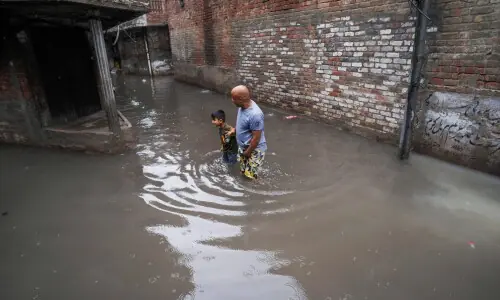
This is hardly surprising for Karachi residents, who are regularly subjected to power shutdowns, the absence of piped water, shortage of public transport, gas load-shedding, broken roads, street crime, toxic air quality, criminal tree-cutting, and other challenges. Despite these odds, the city remains the major contributor to national GDP and revenues from direct and indirect taxation.
Karachi has long been aspiring to a semi-autonomous governance model to address its issues. Barring the City District Government format under Gen Musharraf, this demand has not been realised. As a result of a controversial electoral process, 245 union committees, 25 town municipal corporations, and a metropolitan corporation came into existence about a year ago. All of them are still trying to find a visible role to play in managing Karachi’s core affairs. With a limited financial base and executive capacity, people justifiably see these local government organs as mere cosmetic entities.
Karachi’s political economy is complex. There are many overt and covert interest groups, who have their fingerprints all over the decisions pertaining to Karachi’s development and management.
The EIU’s recent ranking of Karachi is not surprising.
Local and international investors and developers attempt to safeguard everything that fuels their business. One observes endless land supply for investment, albeit at the cost of farmlands, fruit orchards, and indigenous settlements. The eviction of people in planned and unplanned localities is an ongoing nightmare. Whereas a few investors amass exponential profits, millions see their lives altered for the worse after forced dislocations. The realtors are abetted in their projects by the provincial authorities, the city administration, and high-flying engineers, architects, contractors and service providers.
Utility agencies bend the rules to extend their services to these schemes. The mystery of the status of the K-4 Bulk Water Supply Scheme for over a decade is an example. To benefit privileged localities, K-4’s right of way has been changed. A resident in Bahria Town receives uninterrupted water supply while another in Federal B Area has to run from pillar to post to access water.
To promote costly and state-subsidised buses on a few routes, the authorities have closed operations on many ordinary bus routes where city transporters offered their services at affordable prices. The Bus Rapid Transit is a joke. Constructed at an astronomical cost and inconveniencing residents, the BRT has been Karachi’s most financially and operationally unviable transport option ever. If and when all seven BRT lines are operational, they will cater to only nine per cent of the total passenger trips. BRT beneficiaries will be IFIs, government officials, consultants and contractors. The losers will be Karachiites.
There is a visible housing need in the city that remains unmet due to multiple reasons. For a very long time, the city has been functioning without a development plan with data on demographic trends at city scale, migrations, housing and infrastructure needs, and solutions to urban challenges. For the past many years, no public scheme for housing the urban poor has been announced, despite the fact that thousands of households are added to the existing tally every month.
Land in the peripheries, earmarked for housing low-income communities, has been given to a dubious mega realtor. As a result, existing low- and middle-income neighbourhoods are densifying fast. Single-storeyed home on 80 or 120 square yards are being swiftly replaced with five- or six-storeyed structures. Most of these buildings are built without proper design and supervision. They are virtual death traps for the inhabitants. Many such buildings have already collapsed. Poor ventilation and lack of legal electricity connections make life miserable, especially for the elderly, women and children. Authorities only wake up in the event of an accident, conduct an inquiry and end up suspending a handful of officials.
To address all these concerns, the city’s decision-making and governance mechanism must change. A broad-based steering committee under the Sindh chief minister and composed of representatives from stakeholder groups is needed. The body must be empowered to appraise city affairs and take appropriate decisions. Karachi’s livability will not improve unless appropriate institutional arrangements are put in place to address the challenges faced by the residents.
The writer is an academic and researcher based in Karachi.
Published in Dawn, July 8th, 2024