0
0

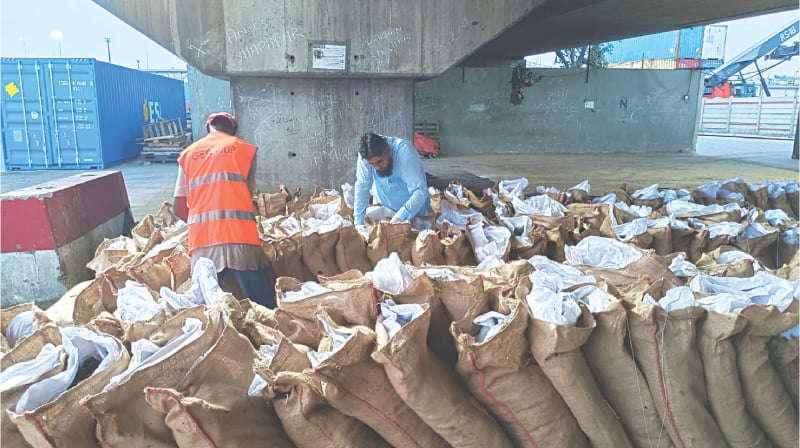
KARACHI: An illegal consignment containing over 17,000kg of Guggul – a dense, high-value, oily resin widely used for treating various disorders in several countries – was confiscated on Monday at Karachi Gateway Terminal in a joint operation by the provincial wildlife department and the Anti-Narcotics Force.
According to officials, the consignment was booked for the United Arab Emirates (UAE). A case has been registered and will be put on trial in the sessions court, district South.
“The precious gum was packed in 355 bags, weighing around 17,935 kg. It’s extracted from a high-value medicinal shrub called Gughar locally,” wildlife field officer Ashfaq Memon said, pointing out that the plant had been declared critically endangered internationally and protected under the provincial law.
“The provincial law places a ban on the extraction of the plant’s secretion, its trade, export, and commercial-scale transportation,” Mr Memon said, adding that the department would send a notice to the exporter to explain the source of this huge bulk of resin.
Over 17,000kg of Guggul was booked for UAE
Deputy Conservator Wildlife Mumtaz Ali Soomro shared that the Kirthar National Park, Rann of Kutch Wildlife Sanctuary, Gorakh Hills, and some parts of Balochistan and Punjab constitute the habitat of Gughar in Pakistan, where the plant grows in the wild.
“This shrub is an integral part of the native ecosystems where it supports diverse wildlife and flora. It grows in harsh climatic conditions and prevents desertification,” he said.
Sources said that the consignment was priced low at Rs5 million in an attempt to save taxes, though its actual worth was around Rs10 million.
Rising trade, declining stocks
According to experts, the shrub Gughar (Commiphora wightii) has traditionally been used as a purifying agent and a tonic that helps rejuvenate cells. Its extracts are also found to inhibit tumour growth and lower blood lipids.
Its gum is used for treating various disorders, either by itself or fortified with other herbs to promote specific actions. “It is also prescribed to treat obesity, rheumatoid arthritis, arteriosclerosis, inflammation, and cardiovascular diseases. Recently, it has been found to exert cytotoxicity against human breast cancer and multiple myeloma,” Dr. Syed Ghulam Musharraf, a senior researcher associated with Karachi University’s HEJ Research Institute of Chemistry, said.
A 2018 study published in the Journal of Ethnopharmacology highlights how the trade of Gughar’s resin has risen in the world while its stocks have depleted in Pakistan and India.
“The C. wightii export trade has particular relevance to the European Union because Belgium, France, Germany, Hungary, Italy, the Netherlands, and the United Kingdom are importing countries. Demand and prices for C. wightii oleo-resin are increasing and wild stocks of C. wightii are in decline,” it says.
It points out that India exports more resin of the plant than it produces, particularly as extracts. “In essence, a long history of over-exploitation in India coupled with a ban on exports from India has transferred the problem to Pakistan, with gum guggul imports from Pakistan to India now filling the supply gap.”
“Improved monitoring of international trade on a species basis can be a useful conservation tool and will overcome the current difficulties in trade data analysis,” it suggests.
Published in Dawn, June 11th, 2024