0
0

NEW DELHI: The release of results of the Indian upended conventional wisdom throughout the six-week election that Prime Minister Narendra Modi’s Hindu nationalist agenda would power him to a landslide win.
Exit polls could not accurately capture discontent among the social and economic castes that are ranked lower in India in key states, resulting in an overestimation of electoral support for ruling party, two pollsters said.
The findings led to turmoil in Indian stock markets on Tuesday, after rosier projections for Modi in the general election earlier boosted markets.
Three of five polls initially projected Modi’s Bharatiya Janata Party (BJP) would win more than the 303 electoral seats it won in 2019, while the opposition “INDIA” alliance led by Rahul Gandhi’s Congress party would win 125 to 182 seats.
Say less privileged voters didn’t disclose their decisions for fear of being attacked
The predictions boosted financial markets ahead of the release of elections results on Tuesday.
However, vote counts showed much lower numbers - around 240 for the BJP and 293 for Modi’s alliance that includes regional parties. That caused the worst intraday fall in stocks since March 2020 on concerns over challenges for implementing economic reforms due to Modi’s dependence on allies.
Pradeep Gupta, head of Axis My India poll agency, said the survey failed to capture a shift among voters in the less privileged sections of society in Uttar Pradesh, West Bengal and Maharashtra states, where 170 seats in total were up for grabs, and where BJP lost a whopping 45 seats, compared to 2019.
“This is our mistake,” Gupta said.
He noted many voters in those sections of society didn’t disclose their voting decisions for fear of being attacked by electoral workers who did not share their political views.
“We could not predict as accurately as we are known for,” he said, referring to challenges in capturing how voters had swung in favour of the opposition from other regional parties.
Over 900 people were deployed for face-to-face post-ballot interviews with a sample of 582,000 voters, with the response rate varying from 40-50% in urban areas and 70-80% in rural areas, Gupta said.
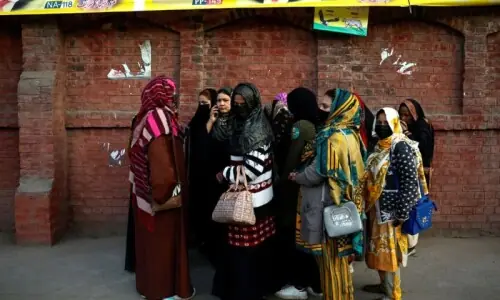
Many women voters asked males in their families to respond on their behalf, resulting in wrong estimations of their voting decisions, he said.
“We are wrong in 2024,” said Yashwant Deshmukh, head of CVoter polling agency, whose numbers were overestimated by about 50 seats in favour of Modi’s party amid incorrect projections for Uttar Pradesh and Rajasthan.
“I wish I could stop giving seat numbers but that’s a professional hazard” as the media keeps asking for those estimates, Deshmukh said.
Published in Dawn, June 6th, 2024