KARACHI: The Sindh government plans to introduce advanced artificial intelligence (AI) technology at the Jinnah Postgraduate Medical Centre (JPMC), which would not only improve patient care but also provide access to data for research and help the hospital develop its own protocols for different diseases.
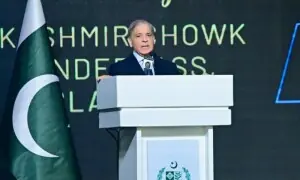
This was announced by Sindh Chief Minister (CM) Murad Ali Shah at the 2nd Postgraduate Research Conference organised by the JPMC at its auditorium on Friday.
Speaking at the gathering, the CM said: “This will be the first time outside the US that advanced AI technology will be deployed to make predictive algorithms based and trained on the local Pakistani population and disease patterns.”
“For this purpose, the Sindh government in collaboration with the Patient Aids Foundation has engaged the world’s renowned firm PAXERA to install PACS (Picture Archiving and Communication System) and artificial intelligence technologies at the JPMC, which are currently being used at Johns Hopkins Hospital and Harvard Medical School’s Mass General Hospital in the USA.”
Mr Shah also shared that the provincial government also planned to give open access to those AI models to other institutes, especially in rural areas, where less experienced doctors could emulate the same level of accuracy as the JPMC in disease diagnosis using AI.
Health facility organises 2nd Postgraduate Research Conference
“This was not the JPMC inherited from the federal government. At the time of the devolution of the JPMC, the National Institute of Cardiovascular Diseases (NICVD) and National Institute of Child Health (NICH) in 2011, their bed capacity was 2,092 with a budget of Rs1.9 billion,” he recalled.
The government, Mr Shah pointed out, had increased their bed capacities and their budgets. “In 2011, the JPMC had 1,185 beds, the NICH 443 and NICVD 464. Today, the JPMC has 2,208 beds, NICH 553 and NICVD 1,280. The government has also enhanced their budgets from a total of Rs1.9bn to Rs25.75bn today.”
Mr Shah informed the audience that the government had also introduced cutting-edge technologies such as CyberKnife and Tomo Therapy free of cost.
In his remarks, JPMC executive director Prof Shahid Rasool expressed his gratitude to the government and the PAF for helping the hospital become one of the largest health facilities in the country.
Higher Education Commission-Sindh Chairman Prof Tariq Rafi, vice chancellors Prof Nusrat Shah, Amjad Siraj and Gulshan Memon, and Aga Khan University Health Services-Pakistan Chief Executive Officer Dr Farhat Abbas also spoke.
Published in Dawn, June 1st, 2024