0
0

LAHORE: As a culture of strikes prevalent in the lawyers community purportedly derails the judicial functions and brings bar associations in conflict with the judiciary, Lahore High Court (LHC) Chief Justice Malik Shahzad Khan on Friday said the bench did not want confrontation with anyone, but it took two hands to clap.
The remarks made by the top LHC judge at the closing ceremony of a pre-service training course for newly appointed judges in the district judiciary came against the backdrop of a months-long strike in Lahore against the ‘unilateral’ decision of the LHC CJ to shift courts from Lower Mall to Model Town.
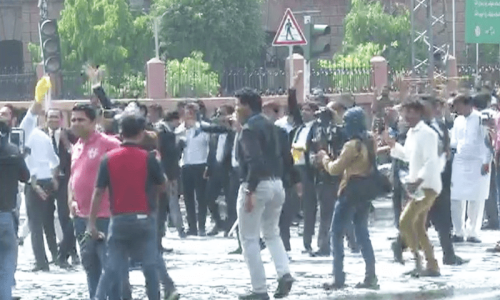
As a result of this strike, the case filing branch at the civil court remained shut for at least 73 days, causing problems for the litigants and lawyers. A recent protest against the CJ by lawyers resulted in clashes with the police, prompting a nationwide strike by the legal community.
According to the LHC CJ, “We do not want to have conflicts with any bar, any institution, or any government” as it weakens the institutions. However, he said a clap required both hands as it could not take one hand to clap. Similarly, respect would be given by the bench as long as the courts were given respect. “If there is no respect for the courts, then do not expect it from us either. We would act according to the law and do nothing outside of it,” CJ Khan asserted.
LHC CJ Malik Shahzad Khan says respect is a ‘two-way street’
The LHC chief justice said that there were about 1.4 million cases pending in the district judiciary and one of the major causes of delays in cases was the culture of strikes. He noted that in the recent past, the courts in Lahore were shut down for 73 days and the law of the jungle was imposed in the provincial capital, denying the public their right of access to justice. He, however, acknowledged that over “90 per cent of the lawyers were professional”, and they supported the effort to end the strike culture.
He further said Chief Justice of Pakistan Qazi Faez Isa and other SC judges played a significant role in ending the strike culture. He said despite strike calls, the CJP and other judges continued to hear cases. He said everyone must fulfil their constitutional responsibilities. However, he noted that the district judiciary was still short of 800 judges.
Addressing the judges, CJ Khan advised them not to become a ‘B team’ of the government, any agency, or some other institution and adjudicate without any fear.
“Administering justice is a divine attribute. A judge is chosen by Allah and a judge is fearless, free from greed, brave, and wise,” the chief justice said, adding that being a judge was not a job where “one fears losing it”. He said the judicial system was not made for the powerful but for the redressal of the oppressed. He said the powerful could get his ‘right’ by force but the weak needed the justice system.
Published in Dawn, May 25th, 2024