India’s poll panel seeks responses to complaints against Modi, Rahul Gandhi


India’s Election Commission said on Thursday it sought responses from the ruling Bharatiya Janata Party (BJP) and the opposition Congress on alleged violations of poll rules by Prime Minister Narendra Modi and opposition leader Rahul Gandhi.
India is holding the world’s largest election over seven phases, with votes due to be counted on June 4.
In their complaints to the commission, the BJP accused Gandhi and Congress accused Modi of making divisive speeches on religion, caste and linguistic issues, notices from the panel said.
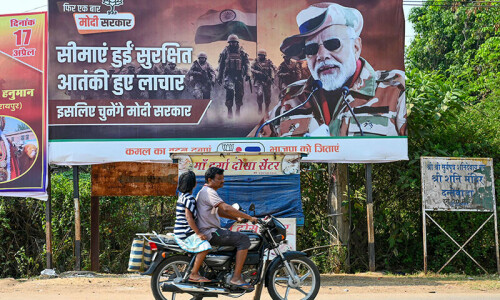
Modi, who is seeking a rare third consecutive term, referred to Muslims as “infiltrators” and “those who have more children” during a campaign speech on Sunday, drawing widespread criticism from opposition groups and a complaint from Congress to the poll panel.
The BJP has said in its complaint that Gandhi sought to create divisions based on linguistic and cultural issues.
The election panel has sought responses from BJP president JP Nadda and Congress president Mallikarjun Kharge by April 29.
India sieves online deluge to stamp out disinformation
As nearly a billion voters head to the polls, officials like Indian Forest Service official Surya Sen counter rapidly spreading online misinformation from election cells that also monitor television and public camera images.
“Social media is the primary ground for misinformation,” said Sen, whose team monitors social media from an office in India’s Silicon Valley city of Bengaluru.
Sen works with an external agency, where 30 people use keyword-tracking software and monitor high-profile influencers around the clock. His operation is one of hundreds nationwide coordinating with India’s election commission.
At the same time, Sen’s in-house team of 40 sifts online posts by political parties to detect everything from hate speech to fake news that violates polling rules.
Just last week, two AI-generated deepfake videos of Bollywood stars criticising Modi and asking people to vote for the opposition Congress went viral, drawing half a million views.
Many were deleted but some are still online, despite two police investigations in the financial capital of Mumbai.
In a statement, the Election Commission said its officials across India had received “instructions to be proactive in scotching fake news on social media”.
Sen showed Reuters his messaging app WhatsApp, which was constantly buzzing with alerts from the external agency flagging content that could disrupt public order or violate election rules, such as the use of hate speech.
These were among the results of online searches for terms such as “Modi” and “democracy”.
Sen did not identify the external agency, which also tracks posts from a private list of social media influencers with numerous followers, giving them an increasingly louder voice in shaping the public narrative in India.
“We cannot do this job ourselves,” Sen said, explaining why the work had to be outsourced. “We do not have the expertise and resources … [It] is a very, very difficult job.”
Suspect posts are flagged to senior election officials for further action, such as directives to Facebook or X to remove content, or legal action against users.
Sen added that 36 such cases have so far been registered in Karnataka, the southern state that houses Bengaluru.
Since the last general elections in 2019, the number of internet users in India has swelled 43 per cent to about 820 million, fed by the growing use of smartphones and Facebook, WhatsApp and X.
In a similar office in northern Uttar Pradesh, India’s most populous state with 240m people, Reuters encountered just two people working on laptops amid rusting metal racks, tracking online posts by repeatedly refreshing pages.
The team manually reviewed all posts on X that tagged the state election panel’s account, ran keyword searches every 20 minutes and used tools such as Google image search to run authenticity checks before flagging controversial content.
“We were not given any formal training or any specialised software,” said one of the invigilators, Harsh Vardhan Singh. “We keep an eye on every post.”