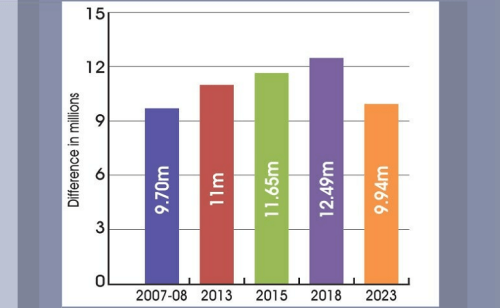
ISLAMABAD: Even though the number of registered voters in Pakistan has crossed the 130 million-mark, the gender gap remains unchanged, i.e. below 10m, the latest statistics released by the Election Commission of Pakistan (ECP) show.
It may be noted that the total number of voters in December 2023 stood at 128m, indicating an increase of over 2m voters between then and now.
According to the ECP, these registered voters include more than 60m (46.18pc) women and a little over 70m (53.82pc) men, with the gap coming to 9.95m.
An analysis of the data suggests that out of the 9.95m — the number of voters constituting the gender gap — Punjab contributes a difference of over 5m, followed by Sindh (2.24m), Khyber Pakhtunkhwa (1.96m), and Balochistan (0.662m).
Punjab leads with difference of over 5m between registered male, female voters
The total number of registered voters in Punjab stands at 74.08m, including 39.56m (53.40pc) male and 34.53m (46.60pc) female voters.
Sindh has 27.33m people enrolled as voters, including 14.78m (54.09pc) male and 12.54m (45.91pc) female voters.
KP has a total of 22.17m voters, out of which 12.07m (54.43pc) are men and 10.11m (45.57pc) women.
The total number of voters in Balochistan stands at 5.43m. This includes a little over 3m (56.09pc) male voters and 2.38m (43.91pc) female.
In Islamabad’s over 1m voters, the number of male voters is 0.574m (52.46pc), while 0.520m women (47.53pc) are registered on electoral rolls.
Seven districts of Punjab contribute to the gender gap of around 2m. These are Lahore (0.410m), Faisalabad (0.384m), Gujranwala (0.256m), Rahim Yar Khan (0.254m), Kasur (0.221m), Sheikhupura (0.212m) and Sialkot (0.210m).
Sheikhupura was the only district in Punjab to have a proportion of female voters below 45pc, prior to the general elections 2024, with the women in the district constituting 44.96pc of the total voters. The district is now out of the list with proportion of female voters reaching 45.06pc.
The number of young voters, between the age group of 18 and 35 years, has swelled to 58.12m, as per the latest age-wise data. According to the statistics, there are now 24.66m registered voters between the age of 18 and 25 years across the country, whereas 33.46m voters are in the age bracket of 26-35 years.
Another 28.83m voters are between the age of 36 and 45 years. That means a total of 86.95m (66.88pc) of the 130m voters are below the age of 45 years.
Published in Dawn, April 16th, 2024