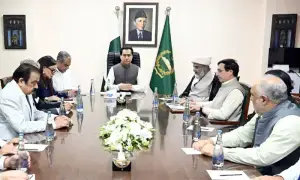
INTERNATIONAL Women’s Day is in March. Throughout the month, there are women’s rights marches, celebrations, and conferences, globally and in Pakistan. During the same month, the new federal and provincial cabinets in Sindh and Punjab were sworn in. Each cabinet has at least two dozen men and one woman only. The KP cabinet has no women. The Balochistan cabinet, yet to be formed, is likely to exclude women altogether. It’s a safe bet that advisers, chief secretaries, and other government members will be predominantly male as well.
Pakistan will most markedly suffer from the absence of Hina Rabbani Khar, whose performance as foreign minister raised the bar for experience and competence in the foreign ministry. Likewise, not reinstating Sherry Rehman as climate change minister threatens to undo the progress Pakistan made at COP27, establishing it as a country deserving of a ground-breaking loss and damage fund due to climate change caused by industrialised nations.
Perhaps women have been put off by the ugliness of the Pakistani political scene; perhaps they are able to see through the repetitive cycles of revenge politics and election manipulation, and choose not to participate in an inauthentic mimicry of representative democracy. But the more obvious argument is that Pakistani women are excluded from the running before they even have the chance to opt in or out. Because women are still invisible in public life, men do not even see women as leaders.
In the 21st century, this unconscious, and sometimes very conscious and blatant, bias is only to Pakistan’s disadvantage, wasting 50 per cent of the talent, education, experience and intelligence in a country already suffering from brain drain. The non-inclusion of women in the political leadership, apart from the few handpicked tokens chosen for their blood ties and loyalty to the leading families, is harmful on many levels.
Not including women in the political leadership is harmful.
Julia Middleton, the founder of Common Purpose, a global leadership development organisation, observed that countries with female leadership fared better during the Covid-19 pandemic, and in handling the climate crisis and other disasters, than countries led by men.
Intrigued by this finding, Middleton surmised that women must create their own pathways to success rather than follow the template of men. Middleton created another organisation called Women Emerging; she and her first cohort of global participants set off on a six-month-long ‘expedition’ to discover approaches to leadership that resonate with women in different parts of the world.
Pakistani psychiatrist Dr Ayesha Mian, who had made her own leap from clinical practice to entrepreneurship during the pandemic, was among that historical first cohort; she is now in the process of launching a Women Emerging chapter in Pakistan. This initiative will select Pakistani women from the organisational and corporate sectors for their own six-month expedition, in which they will explore elements of leadership that resonate with the strengths and competencies of women.
During the expedition, the women will focus on three E’s: their essence, or what is core to their identity; the elements around them in an organisation, country and culture that they must navigate; and their energy, in which essence and elements are aligned to create shift and impact in a positive feedback loop that will strengthen and embolden women on their leadership journey. In this way, the women will gain agency and become change agents, becoming part of a global network of women on similar expeditions around the world.
The Women Emerging model is not a conventional leadership programme, and nor will Women Emerging teach preformed, pre-designed business skills, such as reading a budget sheet or creating corporate strategy. Instead, fellows of the programme are taken through a group-based exploration of their own through conversation with women leaders from different parts of the world with other women in their peer group, and in one-on-one sessions. This avoids the by now rather tired concept of empowerment, which implies imposed, rather than organic, personal and professional development.
The programme has its own unique curriculum, based in large part on the 100 podcasts that were recorded with the participants of the first global Women Emerging expedition on a variety of subjects pertaining to women and leadership. But this is not passive, one-way learning; Pakistani participants will add their own ‘ingredients’ to the global network of knowledge that the Women Emerging programme is building. It may be experimental, but don’t underestimate the value of creating alternative routes to success. When the patriarchal establishment doesn’t allow women to take part in the political process, women will find the strength to chart their own course to the top.
The writer is an author.
X: @binashah
Published in Dawn, March 16th, 2024