Protests erupt in India over contentious citizenship law


 0
0


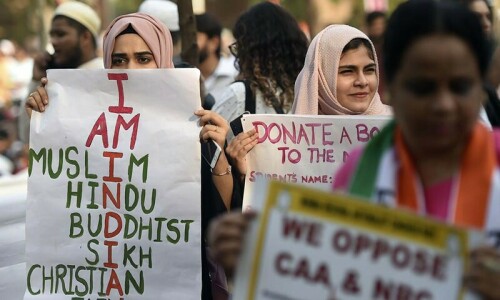
GUWAHATI: Sporadic protests have erupted in India against a controversial citizenship law that has been criticised for discriminating against Muslims, after Prime Minister Narendra Modi’s government implemented the legislation just days before a general election is announced.
Protests broke out in the eastern state of Assam and the southern state of Tamil Nadu late on Monday evening after the implementation was announced, authorities said.
However, there were no reports of damage or any clashes with security forces.
Modi’s Hindu nationalist Bharatiya Janata Party (BJP) government framed rules to implement the Citizenship Amendment Act (CAA), making it easy only for non-Muslim refugees from three Muslim-majority South Asian nations to get Indian citizenship.
Amended law excludes Muslims in grant of Indian citizenship
The enactment of the law in 2019 had led to massive protests and sectarian violence in which scores were killed, forcing the government to delay its implementation.
In Chennai, Tamil Nadu’s capital, protesters took out a candle-light march and shouted slogans against the law.
In Assam, protesters burnt copies of the law and shouted slogans on Monday night, and local opposition parties have called for a state-wide strike on Tuesday.
Many oppose the CAA in Assam as they fear it can increase migration from neighbouring Muslim Bangladesh, a longstanding flashpoint that has polarised the state for decades.
The Communist Party of India (Marxist), which rules the southern state of Kerala, had called for state-wide protests on Tuesday.
“Kerala will stand united in opposing this communal and divisive law,” Chief Minister Pinarayi Vijayan said in a post on X, among several opposition chief ministers who have criticised implementation of CAA.
Authorities in the national capital New Delhi, where the protests were centred in 2019, were on alert for any violence, prohibiting unlawful gatherings and increasing police presence in sensitive areas.
CAA grants Indian nationality to Hindus, Parsis, Sikhs, Buddhists, Jains and Christians who fled to Hindu-majority India due to religious persecution in Afghanistan, Bangladesh and Pakistan before December 31, 2014.
Rights activists and Muslim groups say the law, combined with a proposed national register of citizens, can discriminate against India’s 200 million Muslims. Some fear the government might remove the citizenship of Muslims without documents in some border states.
Published in Dawn, March 13th, 2024