0
0

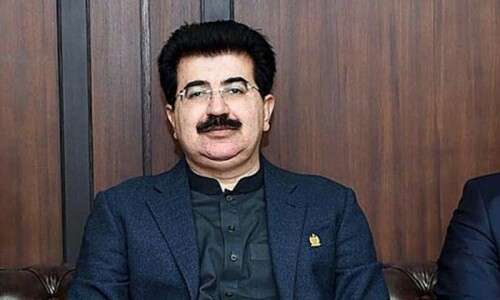
ISLAMABAD: Senator Mushahid Hussain Sayed on Thursday said the ingredients of China’s success story were its quality leadership, ability to do course correction, continuity of policy and peaceful foreign policy.
He was speaking at book launch titled ‘China at 75: China Story – Standing Up to Getting Rich to Becoming Strong’, by Shakeel Ahmad Ramay, CEO Asian Institute of Eco-Civilization, Research and Development (AIERD).
The event was jointly organised by the Institute of Regional Studies (IRS) and AIERD.
Senator Sayed said China could be explained in three words - revolution, reform and rise, and each era was led by a leader right from the front.
“If we look at all the leaders that have led China we will see that they were a product of merit-based system,” he said.
Giving the example of the current Chinese president, Xi Jingping, and its former leader Deng Xiaoping, Mr Sayed said these leaders had integrity and had risen from the grassroots level.
Talking about course correction, the senator explained: “When you feel that perhaps we are not on the right track, you do a course correction,” which the Chinese leadership had done successfully.
He said other aspects were continuity of policy that had spanned decades, humility and the urge to learn from others. However, the most important ingredient was China’s peaceful foreign policy, he added.
Elaborating his point, he said China was the only permanent member of the UN Security Council that had not fought a war with any country during the last 40 years.
He said President Xi Jingping was a leader with a difference, who was confident, competent and had strategic clarity.
He said by the time Mao Zedong died, China had resolved the core issues of its people, which were food, clothing, shelter, health and basic education.
He said Pakistan was fortunate to have China as its neighbour; which was its all-weather friend, strategic partner and an iron brother.
Delving on Mr Ramay’s book, Mushahid Hussain Sayed said the author had told China’s story very well and had captured the country’s evolution in detail.
Deputy Chief of Mission, Chinese embassy, Shi Yuanqiang praised Shakeel Ahmad Ramay for his study of China, his deep understanding of the country’s dynamics and his indepth analysis.
He said Mr Ramay’s book was comprehensive as it had detailed China’s growth right from its establishment to the present time. He said the fundamental reason behind China’s growth was its strong leadership, whose main aim was seeking happiness and well-being of the Chinese people. He said the Communist Party of China had overcome numerous challenges.
Speaking on the occasion, Shakeel Ahmad Ramay said he had divided his presentation into three parts – standing tall, getting rich and becoming strong.
He said when the People’s Republic of China was established in 1949, the country faced a number of challenges.
“After the war, the opposing parties, while withdrawing, destroyed the production base like factories and irrigation system as a result, the country had to face weak production system, inflation, food insecurity and low life expectancy,” he said.
However, Mr Ramay said, the greatest challenge confronting China at that time was not being recognised, especially by the western countries.
These countries were more inclined towards Republic of China that was based in Taiwan. However, Pakistan was the fourth country to recognise China and establish diplomatic relations, the author said.
From here, Chairman Mao Zedong took the lead and along with his companions, started building the country, he said, adding that China first controlled inflation and managed food security as it was the fundamental need of the people and vital for stability.
Published in Dawn, March 8th, 2024