0
0
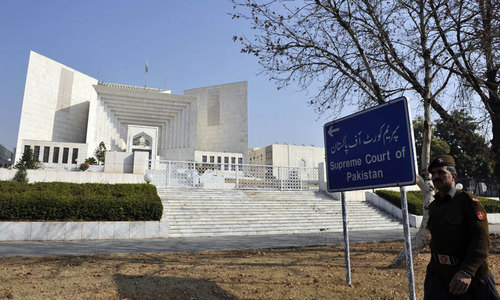
ISLAMABAD: To prevent innocent persons from being falsely implicated, the Supreme Court on Tuesday ruled that any information obtained from an informant (mukhbir) should always be recorded or put into writing by the law enforcing agency, for the sake of fair play.
“We have noticed in a number of cases that police arrest or harass innocent persons for ulterior motives on the basis of suspicion or on the pretext of terrorism, without any solid or cogent evidence,” regretted Justice Jamal Khan Mandokhail in a judgement he wrote.
The case against the petitioner was initiated on an informant’s information, but it was not put into writing and the manner in which the petitioner was ‘implicated’ in the case was not free from doubt, according to the Supreme Court verdict on his appeal against the Sindh High Court (SHC) decision on Jan 19, 2022.
Setting aside the high court’s decision with an order to immediately acquit the appellant, the SC observed that the prosecution was required to produce tangible and high quality evidence to prove the offence to convict him in view of the gravity and seriousness of the offences.
Move aimed at preventing implication of innocent persons on basis of suspicions; court orders acquittal of ‘terror convict’ for lack of evidence
The same, however, was lacking in this case, noted Justice Mandokhail, heading a three-judge SC bench that took up the appeal of Zain Shahid.
The appellant was accused of collecting donations for a proscribed organisation, ‘Daesh’, which could be used to carry out terror activities across Pakistan.
The case at hand revolves around ‘information’ received by ASI Mohammad Hashim on March 26, 2020.
On his complaint, an FIR was regis-tered at the CTD police station, Karachi Central district, under the Anti-Terrorism Act, 1997.
According to the prosecution, the investigation officer (IO) was on patrol on June 18, 2020 when he received a call from an ‘informer’ that the petitioner along with an accomplice was collecting funds for the banned outfit and that the funds would be used to instill fear in society.
The IO claimed that he arrested the petitioner whereas his companion made good his escape.
It is alleged that the petitioner was holding a funding book on which “Daesh Pakistan Fund Raising” was mentioned, besides an amount of Rs1,500 was also recovered from his possession through a recovery memo.
On the completion of investigation, a police report along with evidence was submitted before the trial court, on the basis of which charge was framed against Zain Shahid.
The trial court later sentenced him for 10 years, while the SHC also rejected his plea on Jan 19, 2022.
The SC bench, which set aside the SHC decision with an order to acquit him forthwith for want of evidence, observed that both trial court and high court judges failed to consider the material available on record and did not apply the law “in its true perspective” and thus arrived at a “wrong conclusion” by convicting the petitioner.
Under these circumstances, the decisions by the trial court and that of the SHC were not sustainable, the verdict emphasised.
The apex court noted the petitioner was arrested for possessing a donation book on which “Daesh” was printed and the leaves of which contained his signature, along with an amount of Rs1,500.
However, neither the petitioner signed any leaf of the book in the presence of the prosecution witnesses, nor any leaf with alleged signature of the petitioner was sent to the forensic laboratory, the SC pointed out.
“Under such circumstances, relying upon such weak evidence will result into injustice,” the judgement said.
Had the prosecution considered the petitioner’s actions terrorism, it could have registered a separate FIR, while police investigation report and evidence did not establish the petitioner was busy in collecting funds and his alleged intent to use the same for the purpose of terrorism, the SC judgement noted.
Also, the DIG or any officer of DIG’s office neither participated in the investigation nor appeared before the trial court as a witness to substantiate the FIR content.
Published in Dawn, March 6th, 2024