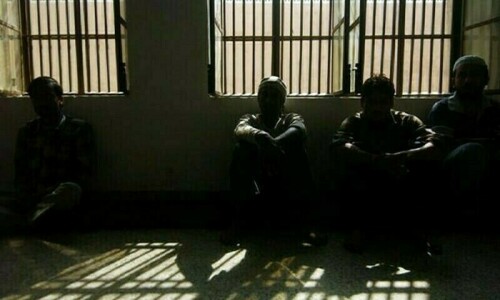
ISLAMABAD: As almost 23,456 Pakistan nationals are imprisoned abroad, mostly in the Gulf countries, the Senate Standing Committee on Human Rights on Tuesday directed the foreign ministry to formulate a much-delayed ‘Uniform Consular Protection Policy’ within three months and get it approved by the government for its implementation.
Senator Walid Iqbal highlighted the non-existence of this policy as it was the constitutional duty of the government to ensure due process of law for all citizens of Pakistan wherever they might be. He informed the Senate committee that then-Lahore High Court Chief Justice Mansoor Ali Shah had directed the formulation of the policy in the Asma Shafi case in 2017.
During the meeting, the foreign ministry officials said that there were currently 23,456 prisoners in foreign prisons, mainly in Saudi Arabia, the UAE, Iraq, Bahrain, Oman, Qatar, India and China. Out of the total number of imprisoned Pakistanis, at least 7,869 were under-trial prisoners.
Senator Mushahid Hussain Sayed inquired about the foreign ministry’s initiatives to provide relief to these prisoners. He also inquired about the status of 2,100 Pakistani prisoners that Saudi Crown Prince Mohammed Bin Salman had announced to release during his visit to Pakistan during the PTI government.
Over 12,000 women prisoners in Pakistan, 40 on death row
The panel was informed by the officials of the Ministry of Interior that Pakistan had entered into prisoner transfer agreements with 11 countries. “Ten were fully effective and one was under process and was yet to be ratified by a foreign government.” The committee observed that while these treaties were government-to-government agreements, their intended beneficiaries were citizens of Pakistan and these accords should be easily accessible and publicly available to everyone. The committee said prisoner transfer agreements should be placed on the websites of the ministries of interior, human rights, overseas Pakistanis and law and justice.
Bangkok Rules
The Senate committee was briefed by the chairperson of the National Commission on the Status of Women (NCSW) on the state of implementation of UN-approved “Bangkok Rules” across Pakistan regarding the treatment of women prisoners and detainees.
In its previous meeting held in December, the committee had sought data on the issue.
NCSW Chairperson Nilofar Bakhtiar stated that there were currently 13,065 women prisoners in the country. 12,258 women were under trial, 767 were convicted, and 40 women were on death row. She further added that around 60 per cent of total prisoners in Punjab were under trial.
The NCSW chairperson highlighted that her office had ensured that five of the well-known imprisoned women political activists, Dr Yasmin Rashid (289 days), Sanam Javed (289 days), Aliya Hamza (289 days), Fehmida Begum (269 days), and Ayesha Bhutta (195 days) continued to be treated in accordance with the Bangkok Rules.
Senator Humayun Mohmand brought the committee’s attention to two Supreme Court judgements in the Tahira Batool case (2022) and the Ghazala case (2023), where it had been ordered that in light of Section 497(1) of the Code of Criminal Procedure women, underage, and sick under-trial prisoners must be granted bails.
The committee unanimously recommended to the NCSW chairperson to inquire into the matter and report to the committee whether bail had been sought by these women activists.
The Senate body was also given a briefing by the secretary of the Ministry of Human Rights on the upcoming periodic report of Pakistan involving the International Covenant on Civil and Political Rights (ICCPR) in March 2024. The committee was apprised that the ICCPR aimed to ensure the protection of civil and political rights. The committee learnt that Pakistan had been asked to report on the key issues of gender equality, violence against women, sexual and reproductive rights, prohibition of torture, overcrowding of jails, child marriage, same-sex union, abolition of the death penalty, enforced disappearances, right to privacy, freedom of assembly, military courts, and child rights. However, Pakistan had a different set of beliefs on the issue of the death penalty and same-sex unions. The human rights ministry had conducted consultative sessions with the stakeholders to obtain relevant information, and a detailed report would be forwarded to the foreign ministry for its onward transmission to the ICCPR committee next month.
Published in Dawn, February 21st, 2024