India, UAE sign pact on trans-continental trade corridor


India and the United Arab Emirates on Tuesday signed an agreement on a trade corridor that aims to connect Europe with India through parts of the Middle East by sea and rail, an ambitious plan backed by the US and the European Union.
His trip comes ahead of India’s national election which is expected to begin in April.
Modi was due to inaugurate the Middle East’s largest Hindu temple on Wednesday, a day after he addresses thousands of expatriates in a community event in the capital Abu Dhabi.
The visit is largely focused on galvanising the diaspora, according to experts, even though Indians in the UAE can’t vote from abroad.
The UAE is home to about 3.5 million Indian nationals — the largest expatriate community in the Gulf country.
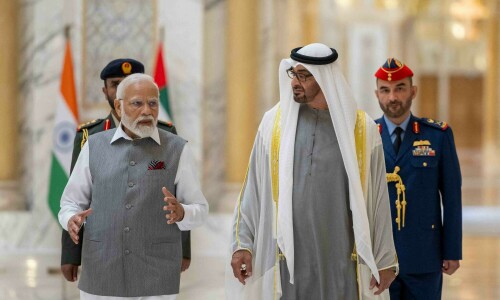
Today, Modi met the UAE president Sheikh Mohamed bin Zayed Al Nahyan, according to the Indian foreign ministry and local state media, their fifth meeting in eight months.
They inked several deals, including a bilateral investment treaty, building on a Comprehensive Economic Partnership Agreement signed in 2022, India’s foreign ministry said.
“This would build on previous understandings and cooperation on this matter and foster India and the UAE cooperation furthering regional connectivity,” the ministry statement said.
The corridor, announced last September on the sidelines of the G20 summit in New Delhi, aims to extend from India across the Arabian Sea to the United Arab Emirates and through Saudi Arabia before connecting through Jordan and Israel to Europe.
The ministry’s statement, however, made no mention of any country apart from India and the UAE, a regional Gulf Arab power, whose ties are built on over a century of trade links.
The agreement on the India-Middle East Economic Corridor comes amid the more than four-month conflict in Gaza that has derailed US-backed plans to further integrate Israel with its Arab neighbours. Saudi Arabia has halted normalisation plans.
The UAE foreign ministry did not immediately respond to an emailed request for comment on details of the agreement.
Modi met with UAE President Sheikh Mohamed bin Zayed al Nahyan, who the Indian leader often refers to as his brother.
“Today, our region is going through a difficult time but because of our relationship with you, we are building a lot of hope and looking forward to a future with India that is on par with our ambitions,” Sheikh Mohamed said at a meeting with Modi on Tuesday, according to video shared on Modi’s YouTube channel.
Regional instability
The UAE forged diplomatic relations with Israel in 2020 under a US-backed initiative known as the Abraham Accords that led to other Arab states including Bahrain establishing ties.
The UAE has maintained those relations with Israel throughout the conflict, though has also repeatedly criticised Israel’s bombing of Gaza and called for a ceasefire.
The framework agreement between India and the UAE appears to signal that both states are pushing forward with the plan to establish the corridor, which may also undermine China’s global trade infrastructure belt and road connectivity strategy.
It has also been signed as Yemen’s Houthi movement has launched attacks on shipping vessels sailing the Red Sea, which the group has said is in protest of Israel’s bombing of Gaza. The attacks have endangered trade via the sea route.
The UAE and India also signed a bilateral investment treaty and exchanged cooperation agreements covering electrical interconnection, trade, and digital infrastructure.
Modi is due to later address tens of thousands of the Indian diaspora at an Abu Dhabi stadium. He will also speak at a summit in Dubai on Wednesday before opening the first ever stone-built Hindu temple in the Middle East in Abu Dhabi.
This is Modi’s seventh visit to the Gulf state since becoming prime minister nearly a decade ago, strengthening ties with one of India’s top trading partners.