KSE-100 index plunges 1,200 points on political uncertainty

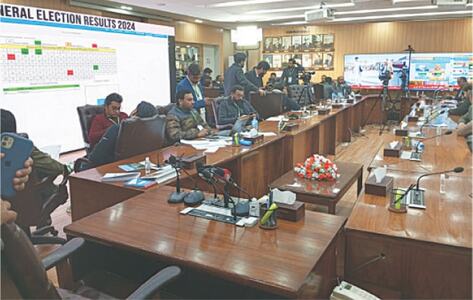
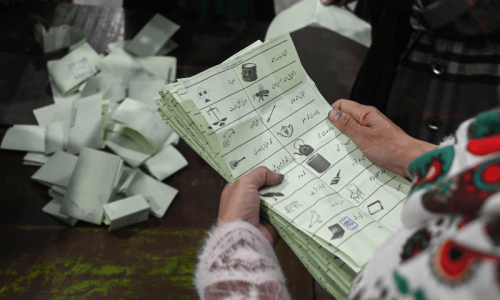
The Pakistan Stock Exchange’s (PSX) benchmark KSE-100 index plunged 1,200 points over political uncertainty on Friday as the results of the general elections trickled in after a protracted delay.
According to the PSX website, the index plunged by 2,278 points shortly after trading began. It then recovered slightly, losing 1,720.27 points, or 2.68 per cent, to stand at 62,423.60 points by 9:30am.
The KSE-100 index finally closed at 62,943.74 points, down 1,200 or 1.87pc from the previous close of 64,143.87.
Topline Securities Ltd CEO Mohammed Sohail said that based on pre-election surveys, the market was expecting a PML-N-led coalition government.
“But based on initial unofficial results, this looks difficult,” he noted.
Ali Malik, CEO of First National Equity, said the market was expecting a politically stable government after yesterday’s elections.
“However, it now seems that there are a lot of independents which could form the next government. The investors will be clear when the results are clear,” he said.
He further said that there was a lot of confusion among investors at the moment, who foresaw political instability with the formation of a government comprising independent candidates.
He said this was the reason that investors were not interested in buying and were looking to sell. “So uncertainty is the key factor for today’s fall,” he said.
JS Global Head of Equity Faran Rizvi said that the market was in the red due to “political uncertainty”, prompting caution for market participants considering long positions.
“Achieving long-term macroeconomic improvement hinges on political stability, a crucial factor to drive the market index towards positive growth,” he said.
Awais Ashraf, director of research at Akseer Research, said there was a lack of a clear majority for any political party, which had created uncertainty regarding the continuation of reforms as well raised question marks regarding future negotiations with the International Monetary Fund (IMF).
“A hung parliament poses challenges for fiscal consolidation and tends to push the ruling regime towards making populist decisions,” he said.