0
0

Founded in 1941, the Jamaat-i-Islami (JI) is Pakistan’s oldest religio-political party, boasting a significant base within the country’s religious segments.
After partition, the JI was reorganised and moved to Pakistan as Jamaat-i-Islami Pakistan. The party’s cadre that remained in India went on to form the Jamaat-i-Islami Hind, a separate organisation that shares JI’s ideological aspirations.
JI’s intellectual inspiration primarily came from Syed Abul Ala Maududi, an ideologue and a staunch proponent of political Islam.
Maududi and 74 others laid the party’s foundation in Lahore on August 26, 1941, to launch a joint struggle to bring in an Islamic revolution.
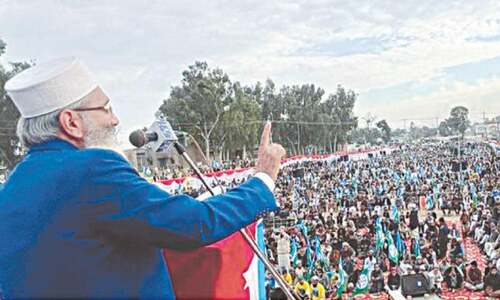
Throughout its history spanning over 80 years, the JI has witnessed the leadership of five emirs. Maulana Maududi led the party from its inception until 1972 and was succeeded by Mian Tufail Muhammad, who held the position until 1987. After that, Qazi Hussain Ahmed assumed leadership in 2008 and was succeeded by Munawar Hassan until 2014. Since then, Sirajul Haq has served as the emir.
JI says it aims to propagate Islam and its teachings amongst all followers of the religion. The party maintains cordial ties with all Muslim states and religio-political lobbies.
The establishment of a state run under Sharia laws is one of the most important features of JI’s mandate. It stands opposed to what it calls Western values and is particularly critical of secularism and the economic systems of capitalism and socialism.
The JI also supported the ‘jihad’ against the Soviets in Afghanistan and backed then-military dictator Ziaul Haq who was leading the anti-Moscow campaign in Pakistan.
After Zia’s death, JI joined a right-wing alliance — Islami Jamhoori Ittehad (IJI) — which operated under the leadership of PML-N supremo Nawaz Sharif and was formed to oppose the PPP in the 1998 general election. By the time the 1993 election happened, IJI had disappeared from the scene and JI preferred to contest under the name of Pakistan Islamic Front (PIF).
The JI was the first party to move the apex court against the Panama Papers leaks. The Supreme Court clubbed several petitions on the same scandal, which led to the ouster of then-premier Nawaz.
Electoral standing
The JI has never been sworn in to lead a federal government but has ruled Khyber Pakhtunkhwa and Balochistan as part of the now-defunct Muttahida Majlis-i-Amal (MMA) — an alliance of various religious parties headed by Maulana Fazlur Rehman’s Jamiat Ulema-i-Islam Fazl and the JI. The JI was also a part of an alliance with the PTI following the 2013 elections.
In 1965, then-military ruler Field Marshal Ayub Khan decided to hold presidential elections in which JI, which was part of the anti-Ayub Pakistan Democratic Movement (PDM), supported Quaid-i-Azam Mohammad Ali Jinnah’s sister Fatima Jinnah. Miss Jinnah lost the election.
In 1970, the party won four National Assembly seats while in 1977, JI contested the election as part of the Pakistan National Alliance.
In 1990, the party participated in the elections under the PIF banner, which did not secure any seats in the NA. Three years later, in 1993, JI once again contested the elections under the PIF banner, this time winning three seats in the lower house of the parliament. However, in 1997, the JI opted to boycott the polls.
In 2002, JI was part of the MMA, which secured 45 NA seats. In 2008, it joined hands with the All Parties Democratic Movement (APDM) which boycotted polls. Five years later, the party won three seats in the NA and allied with the PTI in KP. The coalition, however, faced several ups and downs and by the end of the term, the party left the coalition government.
In the 2018 elections, the JI again contested from the platform of the MMA, which managed to secure 12 seats and 2.5 million votes for the NA.