Maldives vows to boost defences after telling Indian troops to leave


 0
0


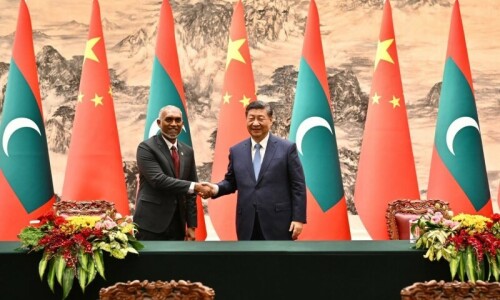
The small but strategically placed Maldives will strengthen its military to defend its vast maritime territory, the new president vowed on Monday after ordering Indian troops to withdraw from the archipelago.
Mohamed Muizzu said in his first address to parliament he would turn the modest Maldivian National Defence Force (MNDF) into a modern military capable of patrolling its seas, which straddle key global shipping lanes.
The pro-China leader reiterated that India will begin withdrawing its troops operating three maritime reconnaissance aircraft from March 10 and complete the process within two months.
New Delhi considers the Indian Ocean archipelago to be within its sphere of influence.
However, the Maldives has shifted into the orbit of China — its largest external creditor — with September’s election of Muizzu, who demanded the Indian troops leave.
“I believe that the modern military capability to defend the country by road, sea and air should be strengthened in the Maldives,” Muizzu said. “We have started to do that now.”
He said the MNDF will soon be able to conduct surveillance of the country’s 900,000 square kilometre (347,000 square mile) Exclusive Economic Zone (EEZ) around the clock.
The Maldives accused India’s coastguard last week of entering the north of its EEZ and intimidating three Maldivian fishing vessels.
Muizzu said he had told India he would not extend a 2019 agreement to jointly carry out hydrographic surveying of the nation’s 1,192 coral islands.
He did not identify India specifically but said he did not want to give “a foreign nation the power to measure and map the Maldivian oceans and coastlines”.
The Maldives are scattered some 800 kilometres (500 miles) across the equator and have become one of the most expensive tourist destinations in South Asia.
Tensions between the Maldives and India flared last month after three of Muizzu’s junior ministers reportedly called Indian Prime Minister Narendra Modi a “clown” and a “terrorist” in since-deleted social media posts.
Indian celebrities urged compatriots to boycott the Maldives and instead book their next holidays closer to home.
Tourism accounts for nearly a third of the Maldives’s economy, with Indians making up a key share of foreign arrivals.