EU ‘concerned’ over Hong Kong’s new security law proposal

The European Union has raised concerns that Hong Kong’s plan for a new national security law may weaken the city’s freedoms, with business leaders calling for greater clarity.
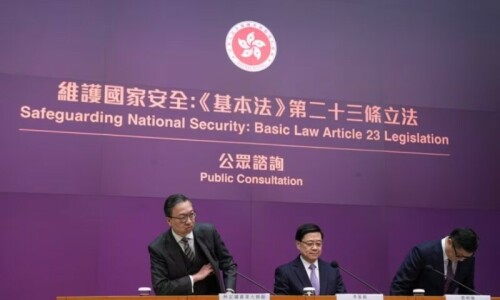
City leader John Lee on Tuesday unveiled a legislative proposal that would introduce new categories of security crimes — on top of an existing national security law imposed by Beijing in 2020.
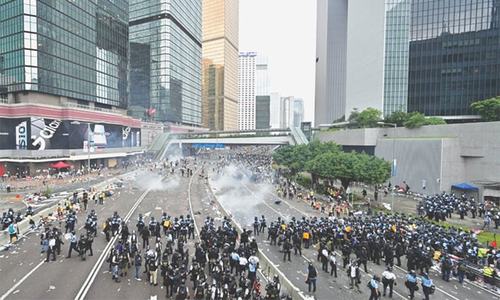
Lee said the new law was needed to avoid a repeat of the “painful experience” of Hong Kong’s huge and sometimes violent pro-democracy protests of 2019.
The EU has expressed concerns that Hong Kong’s current national security law is used to crack down on opposition and stifle dissent, an EU spokesperson told AFP.
“The EU is concerned that some definitions and provisions in the (proposed law) will equal the scope and the draconian measures of the National Security Law, or even go beyond those, and further weaken Hong Kong’s remaining freedoms,” the spokesperson added late on Tuesday.
The United Kingdom’s Foreign, Commonwealth and Development Office said on Wednesday that it will monitor the situation closely, adding that freedoms in the city had been significantly eroded under the guise of national security.
“It is important that new legislation aligns with international standards and upholds the rights promised to the people of Hong Kong,” the office said in a statement.
Britain handed Hong Kong over to China in 1997 under a “one country, two systems” regime, with the city having its own legal system.
Hong Kong officials say the proposed law is a requirement of the city’s mini-constitution, known as the Basic Law, and would target five types of crimes — including treason, espionage and external interference.
Beijing said it fully supported a new security law in Hong Kong, hailing it as guaranteeing “long-term peace and stability” in the semi-autonomous city.
The new law “will help protect the basic wellbeing of all Hong Kong residents, protect the interests of investors from all over the world, and help (it) guarantee high-quality development”, China’s foreign ministry spokesperson Wang Wenbin said.
But Eric Lai, a researcher at Georgetown University’s Centre for Asian Law, told AFP that foreign investors might be wary and free flow of information may suffer.
The proposal is “trying to align the state secret and espionage offences with those in mainland China’s law”, where foreign businesses are often implicated, he added.
Johannes Hack, president of the German Chamber of Commerce in Hong Kong, said he hoped authorities would be more precise in defining state secrets as the term “can potentially cover a lot of ground”.
Hack told AFP that he did not foresee German businesses in the city being affected by the new law, but said it risks being perceived abroad as Hong Kong adding “yet another security law”.