ISLAMABAD: The relationship between the state and media deteriorated during the past two years due to growing instances of censorship, violence against journalists and government disdain for critism, according to a report.
The report titled ‘Under Siege: Legislative, Judicial and Executive Actions Stifling Freedom of Expression and Right to Information’ was published by the Institute of Research, Advocacy and Development (IRADA) as part of its annual state of digital journalism series.
“This year’s report examines key legislative developments in Pakistan during the critical year of 2023, shedding light on recent acts impacting freedom of expression, access to information and the digital media landscape,” Muhammad Aftab Alam, the executive director of IRADA said.
The report investigated the effects of judicial decisions on the overall freedom of expression, indicating nuances in court decisions that both protect and impose restrictions.
Journalists’ arrests raise concerns over press freedom
“The fact that courts have used restrictive interpretations on FOE laws to shut down criticism of courts erodes their credibility to uphold it against other organs of the state. There is a fundamental mistrust of free speech in our post-colonial state structure, where the presumption is against free speech, and a citizen has to prove an exception: as opposed to it being the other way around,” Mr Saroop Ijaz of the Human Rights Watch is quoted as saying in the report.
Concerns
Former Senator Farhatullah Babar, also interviewed and quoted in the report, said, “Digital journalism in Pakistan is facing several challenges, including no legislation in some critical areas, faulty legislation where legislation exists and finally non-implementation of the provisions of the existing law.”
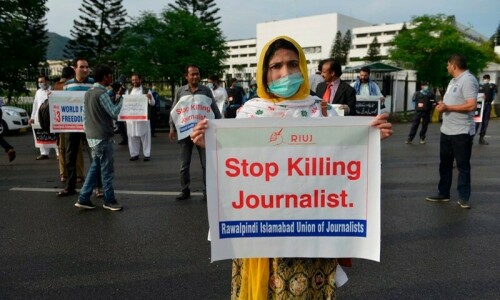
Cases of arrests of journalists, including prominent names such as Imran Riaz Khan and Khalid Jamil, involving the FIA raised concerns about press freedom, transparency, and due process, the report noted.
The report also uncovered a significant number of content removal requests from the Pakistani government to big tech platforms such as Google, Meta, TikTok, and X (formerly Twitter).
For example, between January 2021 to June 2022, Meta restricted access to 12,001 items in Pakistan over PTA complaints for allegedly violating local laws.
The report cited international digital rights organisation AccessNow to show that between 2022 and 2023 there were six internet/network shutdowns across the country, as per directives from the government.
Published in Dawn, January 23rd, 2024