North Korea tests ‘underwater nuclear weapon system’


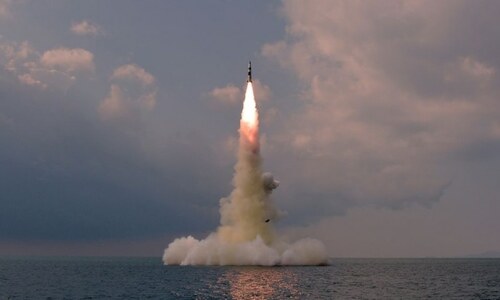
North Korea said on Friday that it had tested an “underwater nuclear weapon system” in response to joint naval exercises by Washington, Seoul, and Tokyo that involved a US nuclear-powered aircraft carrier.
The drills were “seriously threatening the security” of the North, so in response, Pyongyang “conducted an important test of its underwater nuclear weapon system ‘Haeil-5-23’ under development in the East Sea of Korea,” according to a statement from the defence ministry carried by state news agency KCNA.
Early last year, Pyongyang said it had carried out multiple tests of a purported underwater nuclear attack drone — a different version of the Haeil, which means tsunami in Korean — claiming it could unleash a “radioactive tsunami”.
Analysts have questioned whether Pyongyang has such a weapon.
Earlier this week, South Korea, the United States, and Japan carried out joint naval drills in waters off southern Jeju Island, which they said were in response to North Korea’s Sunday launch of a hypersonic missile.
The drills involved nine warships from the three countries, including the aircraft carrier USS Carl Vinson.
Pyongyang on Friday said the drills “constituted a cause of further destabilising the regional situation, and they are an act of seriously threatening the security” of the North, the defence ministry spokesman said, according to KCNA.
North Korea’s own test — the exact date of which was not given — ensured “our army’s underwater nuke-based countering posture is being further rounded off and its various maritime and underwater responsive actions will continue to deter the hostile military maneuvers of the navies of the US and its allies,” the spokesman said.
Recent months have seen a sharp deterioration in long-tense ties between the two Koreas, with both sides jettisoning key tension-reducing agreements, ramping up frontier security, and conducting live-fire drills along the border.
North Korean leader Kim Jong Un last week declared the South his country’s “principal enemy”, jettisoned agencies dedicated to reunification and outreach and threatened war over “even 0.001 mm” of territorial infringement.
Drones deployed?
The new announcement on the underwater test “is a clear sign of Haeil drones deployment to its navy fleets for use”, said Hong Min, a senior analyst at the Korea Institute for National Unification in Seoul.
“The North’s statement illustrates Pyongyang’s stance that it will respond in proportion to military exercise by the South, Japan, and the US,” he said, adding that the North didn’t appear to be trying “to cross the line so as to provoke an armed conflict.”
Ahn Chan-il, a defector-turned-researcher who runs the World Institute for North Korea Studies, told AFP that it was “difficult to determine the exact capabilities” of North Korea’s purported underwater nuclear weapons systems.
“Considering North Korea’s defence science level and the fact that the weapon is still in a developing stage, it is not yet at a stage to pose a significant threat,” he said.
At Pyongyang’s year-end policy meetings, Kim threatened a nuclear attack on the South and called for a build-up of his country’s military arsenal ahead of armed conflict he warned could “break out any time”.
On Sunday, the North launched a solid-fuel hypersonic missile, just days after Pyongyang staged live-fire exercises near the country’s tense maritime border with South Korea, which prompted counter-exercises and evacuation orders for some border islands belonging to the South.
Kim also successfully put a spy satellite into orbit late last year, after receiving what Seoul said was Russian help, in exchange for arms transfers for Moscow’s war in Ukraine.