Soldiers on the streets as Ecuador declares war on cartels

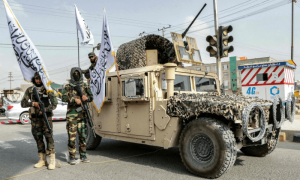
QUITO: Hundreds of soldiers patrolled near-deserted streets in Ecuador’s capital Wednesday after the government and drug mafias declared war on each other, leaving residents gripped with fear.
On Tuesday, officials said another narco boss — Los Lobos leader Fabricio Colon Pico — also escaped since his arrest last Friday for alleged involvement in a plot to assassinate Ecuador’s attorney general.
Ecuador President Daniel Noboa said on Wednesday that his country was “at war” with drug gangs who are holding more than 130 prison guards and other staff hostage and who briefly captured a TV station live on air and set off explosions in a surge of violence that has left city streets deserted.
The small South American country has been plunged into crisis after years of growing control by transnational cartels who use its ports to ship cocaine to the US and Europe.
Gunmen who took over TV studio captured; gangsters threaten to execute civilians
President Daniel Noboa, 36, gave orders on Tuesday to “neutralise” the criminal gangs after gunmen stormed and opened fire in a TV studio and bandits threatened random executions of civilians and security forces.
At least 10 people have been killed in a series of attacks blamed on gangs - eight in Guayaquil, and two “viciously murdered by armed criminals” in the nearby town of Nobol, police said Tuesday.
Riots erupted in several prisons, where more than a hundred guards and administrative staff are being held hostage, the SNAI prisons authority said.
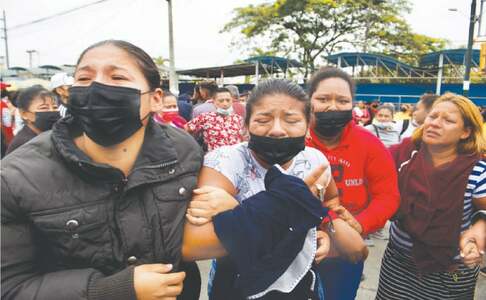
“There is fear, you need to be careful, looking here and there, if you take this bus, what will happen,” a 68-year-old woman told AFP in Quito, on condition of anonymity and describing herself as “terrified.”
In the port city of Guayaquil, attackers wearing balaclavas and firing shots stormed a state-owned TV station on Tuesday, briefly taking several journalists and staff members hostage in dramatic scenes broadcast live before police arrived.
Gangsters also kidnapped several police officers, one of whom was forced at gunpoint to read a statement addressed to Noboa.
“You declared a state of emergency. We declare police, civilians and soldiers to be the spoils of war,” the visibly terrified officer read. The statement added that anyone found on the street after 11:00 pm “will be executed.”
Much of the violence has concentrated in prisons, where clashes between inmates have left more than 460 dead, many beheaded or burnt alive, since February 2021. The country’s murder rate quadrupled from 2018 to 2022 and a record 220 tons of drugs were seized last year.
Noboa said he is targeting 22 criminal groups, the most powerful of which are Los Choneros, Los Lobos, and Tiguerones.
Los Chonero’s leader, Jose Adolfo Macias, aka “Fito”, had been leading the criminal enterprise from his jail cell in Guayaquil for the past 12 years until his escape, announced Monday.
‘Attack on democracy’
The explosion in violence has sparked alarm abroad.
EU foreign policy chief Josep Borrell described the gang activity as a “direct attack on democracy and the rule of law”.
Brian Nichols, the top US diplomat for Latin America, said Washington was “extremely concerned” by the violence and kidnappings, and pledged to provide assistance and to “remain in close contact” with Noboa’s team.
Peru put its border with Ecuador under a state of emergency.
China’s embassy and consulates in Ecuador announced on Wednesday that services to the public were suspended.
France and Russia both advised their citizens against travel to Ecuador.
Geography and corruption are among the reasons that the once peaceful country has evolved into a hotspot of transnational organized crime.
Ecuador borders the world’s two largest cocaine producers, Colombia and Peru.
Guayaquil port, from where most of the drugs are shipped abroad -- often in containers of bananas or in legal shipments by front companies — is seen as having weaker controls.
This has drawn in foreign mafia from Colombia, Mexico and Europe, allied with local gangs who fight brutal wars for control of lucrative drug routes.
Published in Dawn, January 11th, 2024