Red Sea attacks are not isolated incidents, UNSC told


UNITED NATIONS: During a UN Security Council briefing on Wednesday afternoon, some member states emphasised the need to address attacks on ships in the Red Sea.
Some states also called for an immediate ceasefire in Gaza, urging caution to prevent an escalation in tensions.
US ambassador and Deputy Permanent Representative, Christopher Lu, however, called on member states to “speak with one voice and demand that the Houthis stop their attacks”.
He said the threat to navigational rights and freedom in the Red Sea was a global challenge that necessitated “a global response”.
He accused Iran of providing financial and material support to the Houthis and called it “the root of the problem”.
The US diplomat called on the Council to speak with one voice and demand that the Houthis stop their attacks on ships.
“We call for a global response from this Council to this global challenge, and we are ready to discuss the situation further with other member states,” he said.
But Vassily Nebenzia, Russia’s ambassador to the UN, disagreed with the US position. “Nobody should deny that what is happening in the Red Sea is a direct projection of the violence in Gaza, where Israel’s bloody operation has been ongoing for three months,” he said.
The Russian diplomat recalled that escalation was also happening in other occupied Palestinian territories, as well as across the Israel-Lebanon border.
He advised the council to avoid “putting out the fire in the Red Sea with gasoline”, as treating it as an isolated incident would not suffice.
Algeria’s ambassador, Amar Bendjama, said his country recognised the crucial role of Red Sea route as being of “paramount importance for the whole world”. But he said the crisis at sea must be seen within a broader regional context.
“First, the region is currently wracked with instability due to the war in Gaza with the potential of spillover at any moment,” he said. “It is crucial to prevent the emergence of any regional conflict with out of control regional consequences,” he warned.
“The current international and regional instability is the manifestation of yet another profound malaise: the erosion of collective security architecture and weakening of diplomacy,” Mr Bendjama observed.
The head of the UN’s International Maritime Organisation (IMO), Arsenio Dominguez, said 18 shipping companies have decided to reroute their vessels away from the Red Sea to reduce the risk of attacks from Houthis.
“No cause or grievance” could justify continuing Houthi attacks against freedom of navigation in the Red Sea,“ he added.
The IMO chief addressed the overall situation in the region, stating: “We encourage all concerned parties to avoid further escalation and de-escalate tensions and threats.”
UN Assistant Secretary General for the Middle East, Khaled Khiari, warned that the repercussions of military escalations and threats to maritime navigation were of serious concern as these could impact “millions in Yemen, the region, and globally”.
He urged the council to help “avoid further escalation and the risk of regional conflagration”.
Nicolas de Rivière, permanent representative of France, said that “France and all states have the right to take appropriate measures to ensure safety at sea”.
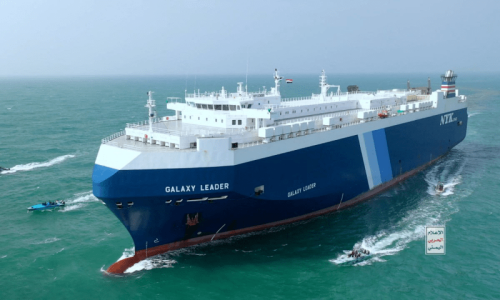
Yamazaki Kazuyuki, Japan’s permanent representative, said his country was outraged by the armed “seizure” and continued holding of the Japanese-operated Galaxy Leader and its 25-person multinational crew, on Nov 19.
The Security Council, he said, must take “appropriate action to deter additional threats” by the Houthis and maintain international peace and security.
Published in Dawn, January 5th, 2024