0
0

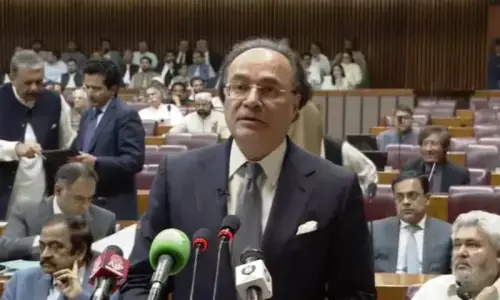
SUKKUR Feb 23: Terming President Musharraf’s China visit vital for Pakistan’s defence, the chairman of Senate’s standing committees on information and defence production, Senator Nisar A. Memon has said the country is strong politically as well as economically.
He was addressing students at the Institute of Business Administration, Sukkur, on Thursday.
The topic of his address was “Governance challenges to Pakistan: Past, Present and Future”.
Senator Memon called upon youth to make efforts for fulfilling the ideals of Pakistan Movement as had been visualized by the founder of the nation Quaid-i-Azam Mohammad Ali Jinnah.
He said the Quaid had always dreamt of an egalitarian society, free from economic and social exploitations in which minorities and men and women should have equal participation. He said that this was the third generation of the country and as earlier generations had almost failed to achieve this purpose, “it is now up to you to sustain and strengthen Pakistan at internal and external fronts”.
Analyzing the 58-year chequered history of the country and genesis of the Pakistan Movement, Senator Memon said that politicians and political parties were responsible for their fragile and weak approach which led to military interventions at intervals.
He said that country’s highest political manoeuvrings took place in 1988 and 1999 after which the system was packed and General Pervez Musharraf took over reins of the power.
He said that country’s leadership badly failed for over nine years to give a constitution and even the 1956 constitution adopted by them failed to deliver after which martial law was imposed and President Ayoub Khan governed the country under controlled democracy.
He said the period of fifties was marked with political instability which followed with controlled democracy in sixties.
Later on political wrangling resulted in 1971 with separation of East Pakistan while the period of eighties was marked with Islamic influence in politics.
Senator Memon said the country got a constitution in 1973 and its authors deserved praise as it was a consensus document.
He said the pre-1999 events were instrumental in weakening state institutions including the executive and judiciary.