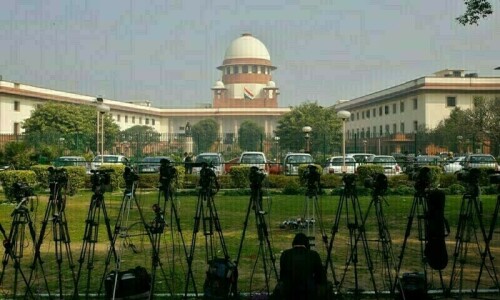
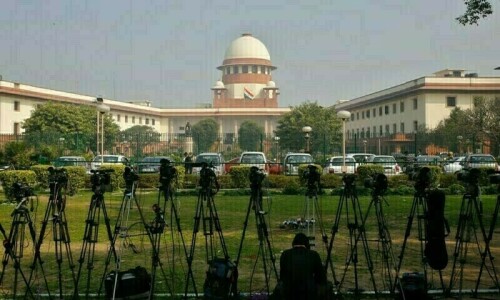
THE Indian supreme court has validated the great injustice committed by New Delhi against the people of held Kashmir in August 2019. Hearing a number of petitions challenging the abrogation of Article 370 of the Indian constitution over four years ago, the court on Monday ruled that the said article “was an interim arrangement”, and that the BJP-led government’s dubious decision to scrap the disputed territory’s limited autonomy was the “culmination of the process of integration”.
Pouring salt on the Kashmiris’ wounds, one of the justices observed that a ‘truth and reconciliation commission’ should be set up in the occupied region to probe rights’ violations.
The learned judge should know that successive Indian governments have systematically denied the Kashmiri people their fundamental rights, and no one believes that an administration that treats Kashmir as conquered territory will seriously look into the abuses perpetrated by its own troops.
Amongst the petitioners were parties that have always been loyal to New Delhi; the Indian state rewarded them for their ‘loyalty’ by reportedly putting Mehbooba Mufti and Omar Abdullah under house arrest before the verdict was announced.
The decision is likely to give the BJP’s Hindutva juggernaut a further boost in next year’s elections, while it is also an attempt to rewrite history. The world recognises Kashmir as a disputed territory, even though India is trying to create new facts on the ground.
The abrogation of Article 370 has allowed India to change held Kashmir’s demographics, and effectively turn Kashmiris into a minority in their ancestral land.
In a related development, Indian Home Minister Amit Shah recently told the Lok Sabha that “Nehruvian blunders” had hurt New Delhi’s case vis-à-vis Kashmir. The ‘blunders’ he was referring to were Jawaharlal Nehru’s acceptance of the ceasefire during the 1947-48 Pakistan-India war, and taking the dispute to the UN.
He added that if these ‘mistakes’ had not been made, Azad Kashmir would today be part of India. Again, these are reflections of the Sangh’s revisionist, revanchist thought, as other Indian ministers have also made irresponsible statements about ‘taking back’ Gilgit-Baltistan.
The court’s decision may strengthen India’s stranglehold over Kashmir, but it cannot extinguish the Kashmiris’ strong desire for freedom and dignity. No amount of Indian legal subterfuge, or brute force, can stop the Kashmiris from demanding their legitimate rights.
Though Pakistan has rejected the Indian court’s decision, unfortunately, successive administrations here have failed to adequately highlight the Kashmir issue diplomatically on the global stage, which has added to India’s brazenness.
Sadly, not all occupations are deemed equal by the ‘international community’, as evident in the fact that the occupation of Kashmir and Palestine is conveniently brushed aside, whilst the occupation of Ukraine is cast as an existential battle between democracy and authoritarianism.
Published in Dawn, December 12th, 2023