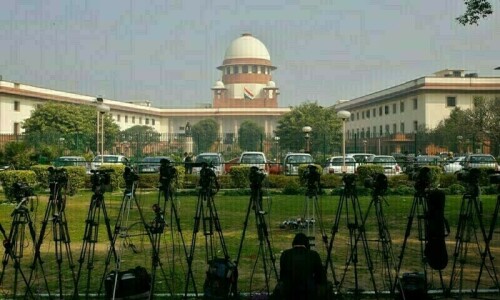
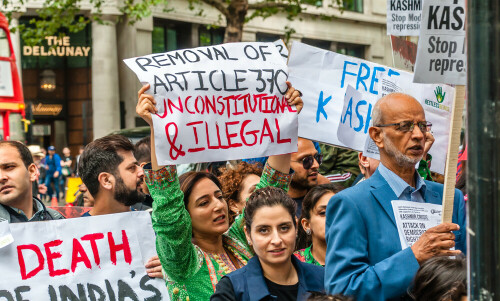
WASHINGTON: The Indian Supreme Court’s endorsement of Prime Minister Narendra Modi’s decision to revoke the special status of the disputed Kashmir territory is seen as a significant boost for him and his party leading up to the upcoming elections, according to US experts.
The decision followed growing calls from the Congress party for the restoration of Jammu and Kashmir’s statehood, adding a layer of complexity to the already contentious issue.
Michael Kugelman, a scholar of South Asian affairs at the Wilson Center in Washington, told Dawn that the court’s verdict was likely to strengthen Modi and the BJP’s position, particularly in light of Congress’s vocal stance on the matter.
“The court verdict will give Modi and the BJP yet another boost as they move toward elections in the spring, especially as the Congress party had grown more vocal over the last year in calling for the restoration of Jammu and Kashmir’s statehood,” he said.
US scholar says decision quells chances of resumption of India-Pakistan dialogue
Mr Kugelman also addressed the implications of the court’s decision on India-Pakistan relations, particularly because Islamabad has conditioned the resumption of formal dialogue on changes in India’s Kashmir policy. He argued that the repeal of Kashmir’s status, reiterated in the court’s decision, seemed to have diminished the possibility of a resumption of formal dialogue.
“In that sense, the court verdict appears to rule out any possibility of Pakistan being willing to relaunch a formal dialogue with India — even though several top Pakistani leaders in recent years have indicated a desire to bury the hatchet with India,” he said.
Shuja Nawaz, a Distinguished Fellow at the South Asia Center, Atlantic Council, outlined the challenges Pakistan would face in the aftermath of the court verdict.
Mr Nawaz, who has authored several books on South Asia, suggested two potential choices for Pakistan: the conversion of Azad Kashmir and Baltistan into de jure provinces with democratic and economic development, or engaging in cross-border unrest with its associated costs and risks. “Indo-Pak cooperation or regional trade may be a challenge in the face of the nationalistic fervour generated by the Modi BJP,” he told Dawn.
As regional dynamics continued to evolve, the court’s decision on the status of Kashmir was likely to have far-reaching consequences on political, diplomatic, and economic fronts, shaping the discourse between India and Pakistan in the foreseeable future, he added.
Published in Dawn, December 12th, 2023