0
0


With all eyes on the UAE, where world leaders have gathered for the COP28 summit, Dawn is speaking to experts to answer pressing, everyday questions that are on people’s minds about climate change-related issues.
Today, Dr Muhammad Tahir Khan, a climate change expert, explains what makes Balochistan vulnerable to natural calamities and how these events are reshaping the province’s geography.
Balochistan has been witnessing the effects of climate change since the late 1990s. Now, the threat has metastasised, and people are on the receiving end. In recent years, the impact was quite distinct in the form of torrential rains and floods that wreaked havoc in the entire province. It was an emergency-like situation, worse than any other province due to Balochistan’s diverse geographical position and huge land mass.
How has climate change impacted Balochistan? How has the threat of climate change diversified in Balochistan?
In Balochistan, the threat of climate change has diversified in the sense that from 2015 to 2018, when I was in Balochistan, it was a critical time in terms of climate change in the province. Geographically, Balochistan is almost half of the country. Its northern parts received heavy snow and torrential rains, while in the central and eastern regions, floods have wreaked havoc over and over again. As for the Makran and Rakhshan divisions, there is a threat of drought. Over the last two decades, the impacts of climate change have continued to worsen.
Have steps been taken to cope with the threat of climate change in Balochistan?
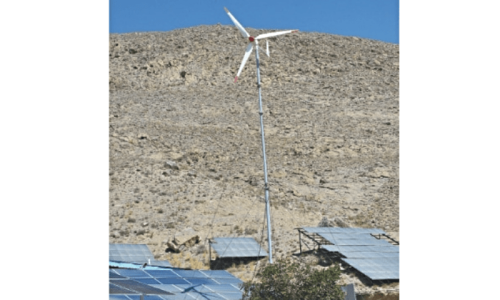
The authorities never had a proper mechanism to cope with the situation in the past, nor do they have now. In some places, residents have migrated due to the worsening climate change. For instance, in the drought-hit parts of the province, people don’t have water for themselves and for their livestock. So, they are compelled to leave their homes for a better place. In many regions, including the drought-hit areas, there are many tube wells extracting water through solar power. But the sad reality, which people are unaware of, is that the water table has depleted due to this extraction. The underground water level has decreased to over 1,200 feet. But, as it seems, no lessons are being learnt.
Published in Dawn, December 3rd, 2023