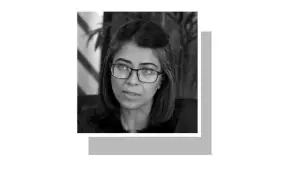
How Mansehra’s ‘Earth Mama’ turns litter into hope



Hifza Zahid, a teacher based in Mansehra, was walking to school from her house on a sunny day when she suddenly noticed the forest nearby littered with plastic bags. The soothing sight of evergreen pine trees was marred with polythene shoppers hanging on deeply fissured barks.
Although upset at the sight, the 28-year-old eventually continued her journey to Jamal Public School. But the same day, two of her brightest students decided to drop out of their classes due to financial constraints.
That day left Hifza deeply unsettled at the time but it sowed the seeds of an idea in her heart that would go on to change several lives.
The teacher has since turned into an entrepreneur who runs a one-of-its-kind business that serves as a guardian angel for her students and Mansehra. ‘Earth Mama’, co-owned by Hifza and her sister Yumna, is based on the model of upcycling — the process of transforming by-products, waste materials, or unwanted products into new materials.

“We sell a range of tote bags, basic and customised, made out of scrap denim,” Hifza told Dawn.com. She purchases the raw materials from flea markets and even repurposes leftover pieces of cloth lying around at local tailor shops, that are used for scrunchies.
Both tote bags and scrunchies are stitched by three of her students — who can now work and study simultaneously without having to choose one of the two things — while Yumnna designs them. A basic tote bag costs Rs400 while a customised bag is sold for Rs1,000.
Hifza launched ‘Earth Mama’ with approximately Rs50,000 from her year-long savings and now aims to ramp up her revenue to Rs200,000 within the next four months.

“The initial response we got is good, but there is still so much more that needs to be done,” she said. The teacher-turned-entrepreneur envisions a day when plastic bags will be completely replaced and the forest near her house will come back to life.
However, Hifza knows the journey to her dreams will require a lot more — both practically and theoretically. Therefore, she enrolled in the Women’s Initiatives in Social Enterprises (WISE), a project run by Jazz and the United Nations Development Programme, the first chance she got.
WISE helps young women entrepreneurs across the country, particularly from underprivileged and rural districts, set up social enterprises whose services and businesses support the implementation of the United Nations Sustainable Development Goals (SDGs).
According to UNDP’s youth economic empowerment officer Jehangir Ashraf, the initiative — which was launched in 2020 — is aimed at empowering women and promoting their economic development across all social groups. So far, over 400 entrepreneurs and 200 enterprises in 13 cities have been provided support and training under the programme.
WISE participants are invited for a four-day boot camp where they are provided training regarding marketing, branding, financial, and administrative aspects of running a business.
At the last such boot camp of 2023, Hifza was one of the entrepreneurs eagerly noting down learnings from the sessions she could take back home.
Along with her, 10 to 12 other women attended the camp. One of them weaved clothes, the other sold home-made jewellery while another supplied beauty products to salons. They hailed from Peshawar, Swabi, Abbottabad, and other cities up north.
Although from different backgrounds, these women were united in their determination to prove themselves, and also their quest for knowledge.
“The camps were an unforgettable experience. They helped me interact with like-minded people which is very difficult in Mansehra,” Hifza told Dawn.com
She admits that her business needs two to three years to enter bigger markets but is confident it has great potential. “I want to see a day when polythene bags are permanently replaced in every part of the country,” she said.
As far as Mansehra is concerned, the teacher will ensure not one student she knows has to ever drop out of school again.