0
0

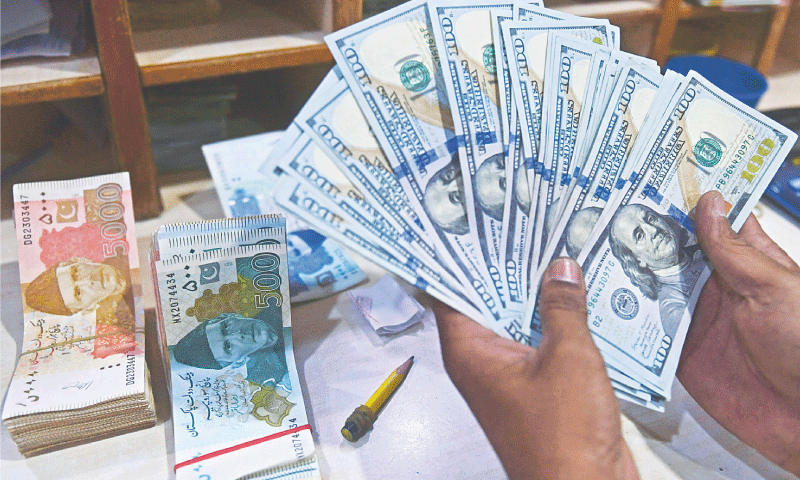
KARACHI: Banks are reluctant to sell dollars amid growing exchange rate uncertainty making it difficult for the importers to open letters of credit (LCs), banking sources told Dawn on Saturday.
Currency dealers said dollar inflows were low this month but the banks were trying to keep maximum liquidity with them. “Banks avoid selling dollars in the banking market which is one of the big reasons for the shortage and appreciation of the greenback,” said Atif Ahmed, a senior banker dealing in the currency market.
He said inflows were low during the current month but did not stop. “Banks are keenly watching the exchange rate trend which is not stable, encouraging them to hold back dollars,” he added.
The State Bank of Pakistan (SBP) and the Ministry of Finance claim that there is no restriction on imports and importers are free to open LCs. Importers deny the claim.
“We import goods for manufacturing of exportable products and earn dollars for the country. The situation is disappointing for us. It will certainly hit exports this year,” said Amir Aziz, an exporter of finished textile products.
Bankers said the dollar again started appreciating as the inflows required for imports and debt servicing are not in the pipeline.
“The economy is not in good shape as claimed by the government. Imports have drastically declined during this fiscal year,” said Mr Amir.
The SBP data showed that exports of goods showed no growth at $9.7bn during the first four months of the current fiscal year over the same period a year ago.
However, imports fell by 20pc to $16.8bn during July-October FY24 compared to $21bn in the same period last year.
The local currency has constantly been under pressure, but the government finds curtailment of imports as a solution to this problem.
Finance Minister Shamshad Akhtar recently said the rupee came under pressure against the dollar from the second week of August this year, mainly on account of uncertainty related to the transition of government to the interim set-up, continuity of economic reforms and the IMF loan programme.
Experts were of the view that weak fundamentals like low inflows, stagnant export growth and poor foreign exchange reserves are behind the weakness of the local currency.
Analysts and independent economists, while calculating the fallouts of 20pc decline in imports, said the import-led growth had gone down to the lowest level, while the overall growth was estimated at less than 2pc in FY24.
The finance minister had said signs of incipient economic recovery were evident and the country’s GDP growth was projected to grow at 2-3pc in FY24, up from 0.3pc in FY23.
The low imports would support the government to minimise the current account deficit at the cost of economic growth. SBP Governor Jameel Ahmed said on Friday that the current account deficit for FY24 would be around 1.5pc of GDP.
Published in Dawn, November 26th, 2023