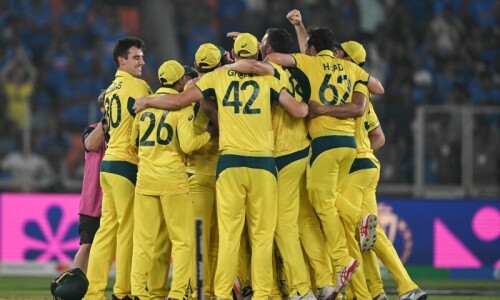
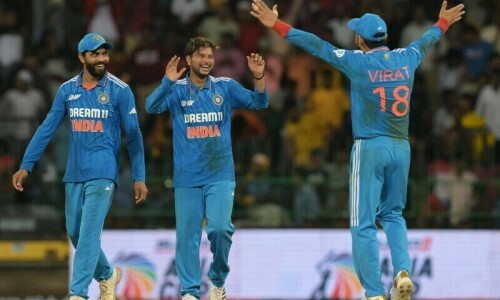
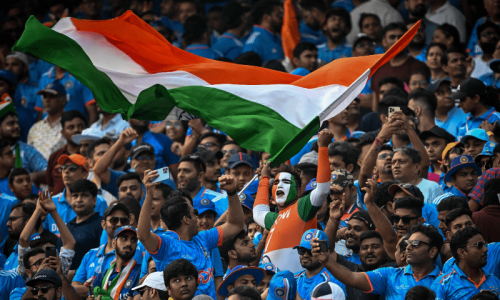
ONCE Australia turned up the heat, the Indian juggernaut came to a stop. Hearts broken, the dream of the Indian nation turned into a nightmare as the biggest game in world cricket came to an end.
India had felt it was their birthright to win their home World Cup at the colossal stadium named after Prime Minister Narendra Modi in his own city and in front of over 120,000 fans. But Australia had other ideas. Skipper Pat Cummins had said he hoped to silence the Ahmedabad crowd and deny India a fairy-tale finish.
His side succeeded in doing just that, romping to a six-wicket victory and emerging as the sport’s dominant force. By the time Cummins held up the trophy as Australia was crowned world champions for the sixth time, the largely pro-India crowd had dispersed.
India had gone unbeaten into the final, having won 10 in a row, while Australia had opened with two defeats before finding its way. In the final, however, it was the Australians who proved to be the better side — a fact not lost on Indian captain Rohit Sharma, who acknowledged his team couldn’t do enough.
Earlier in the tournament, Pakistan failed to reach the semi-finals of a contest which showed One-Day International cricket was alive and kicking. In this age of Twenty20 cricket, Australia and India, as well as beaten semi-finalists New Zealand and South Africa, showed they could adapt to the ebb and flow of ODI cricket.
Despite India’s strong World Cup performance, there is talk of the need for a generational shift there. While Pakistan have younger players, there is a captaincy shift imminent, with Babar Azam having resigned as the team’s all-format captain.
Pakistan could start by working on their one-day outlook; also, while the ODI World Cup is still four years away, they could work towards achieving a stronger 50-over unit by the time they host the Champions Trophy in 2025.
Published in Dawn, November 21st, 2023