UNITED NATIONS: The UN General Assembly has initiated discussions on Security Council reforms, with Pakistan asserting that the lack of consensus among permanent members hindered the council’s ability to address the Gaza conflict.
General Assembly President Dennis Francis also echoed the urgency for reform, amid conflicts raging in Ukraine and Gaza.
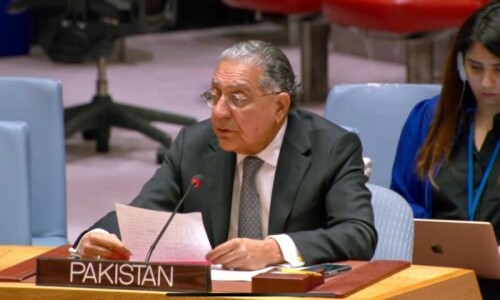
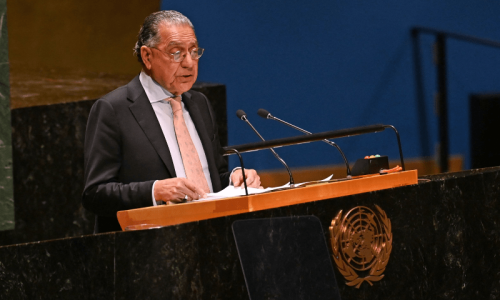
In the debate that began on Thursday, Pakistan’s UN envoy Munir Akram criticised the Security Council for its failure to bring peace to Gaza.
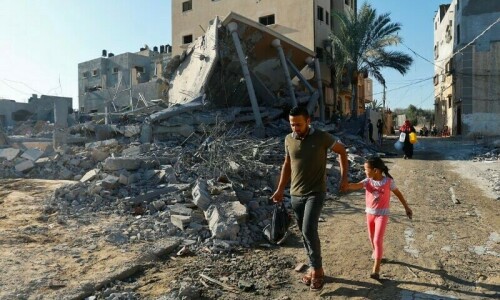
“For more than a month now, a brutal war has raged in Gaza, with blatant war crimes and genocide being perpetrated by Israel against innocent Palestinian women and children.” He emphasised the council’s inability to stop the slaughter, even after adopting resolution No. 2712.
Munir Akram criticises lack of consensus among permanent members over invasion of Gaza
President Francis concurred, stating: “As wars rage in Ukraine and Gaza, never before has the issue of reform of the Security Council been more pressing.”
The General Assembly has grappled with equitable representation since 1979, and the recent crises underscore the need for change.
Ambassador Akram blamed the council’s five permanent members for frequent failures to respond effectively to conflicts, particularly in Gaza. He pointed to vetoed efforts to declare a ceasefire and said: “The primary reason for the Council’s frequent failure to respond effectively…is the inability of its permanent members to agree on decisive action.”
President Francis warned that without structural reform, the council’s performance, legitimacy, and the UN’s credibility and relevance would suffer. He noted that violence and war continue globally while the UN seems paralysed due to the council’s divisions.
Pakistan supports reforms, but opposes adding new permanent members, as demanded by Brazil, Germany, India, and Japan. Ambassador Akram argued against this, stating it would statistically reduce representation for the rest of the member states. He added that the aspirants would be unaccountable and seek to advance their own national interests.
However, Pakistan supports adding longer-term seats to the 15-member Security Council if done equitably. Ambassador Akram stated: “Any country seeking a more frequent presence on the Security Council should do so by subjecting itself to the democratic process of periodic election by the General Assembly.”
Ambassador Jamal Fares Alrowaiei of Bahrain, speaking for the Arab Group, emphasised the urgent need for real reform, criticizing the arbitrary use of the veto that challenges the council’s credibility. He urged member states to enhance conflict prevention efforts for greater representation, transparency, neutrality, and credibility.
Deputy Permanent Representative Nedra P. Miguel, speaking for the L.69 group of developing countries, stressed that the Security Council is “no longer fit for purpose” and called for urgent reform. She criticised the over-representation of Western countries, stating it doesn’t reflect the UN’s diverse composition or current geopolitical realities.
Published in Dawn, November 18th, 2023