0
0

PESHAWAR, Feb 13: Media experts said on Monday that there was a strong link between development in the communication sector and progress in the social sector and urged greater infrastructural commitments for media growth.
“History reveals that development of new media and forms of communication there was nearly always the development of hopes and fears,” said Prof Dr Klaus Beck, chairman of communication science at the University of Greifswald, Germany.
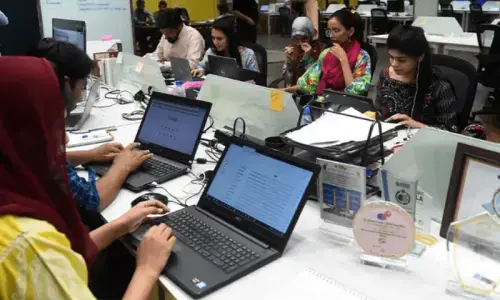
Dr Beck was speaking at the concluding session of a three-day symposium organised by Germany’s Leipzig University in collaboration with the department of journalism and mass communication at the University of Peshawar.
About 13 PhD aspirants in foreign universities also presented their proposed projects on the occasion. Dr Beck was of the view that development of online journalism, especially the Internet, had also raised fears and hopes as far as better communication was concerned.
Some authors, he said, were of the opinion that the Internet would provide means for a more dialogic communication without the political and economic constraints of the so-called “one-way mass media”.
Furthermore, it is also presumed that with the advent of the Internet, chances for more democratic public communication would get a boost as it would allow everybody to act as communicator, he said.
This happens because the Internet cannot be controlled by a single state, ruling party, the military or any other political institution, according to Dr Beck.
Online communication on the Internet serves as a utopia of free flow of information and ideas, political participation, discourse, deliberation and renaissance of democracy, he said, adding that in this way the mass communication process and the mass media manipulated by the economically and politically powerful rulers, will get replaced by a global network of equal and free communicating and deliberating citizens.
“Even the political, religious, ethical and marginalised groups would now get an opportunity to participate in the public sphere,” he said.
Some experts argue that the Internet has an overwhelmingly negative outcome on the public sphere and democratic politics, he said. Quoting some experts, he said that the Internet serves as a collecting tank for radical and extremist pamphlets, gossip, entertainment, advertising and pornography, which is also condemned as a network for criminals and terrorists, who threaten civil liberties and democratic society.
He said that some organisations, such as the Revolutionary Association of Women in Afghanistan (RAWA) established in 1977, had no office in Afghanistan. Initially, it had started its website in 1997, because it had no office back home. Its website was an electronic version of its printed bilingual magazine, which consisted of RAWA’s political programme, such as democracy, secularism and women’s rights.
Through the website, it reported about its secret social work in Afghanistan and in Pakistan’s refugee camps, he said, adding that the website served as office for the RAWA in those trying times.
Prof Dr Altafullah said that media can be used for solving peoples’ problems and setting goals for the government and policy-makers to pursue. He said the media boom had brought the spotlight on world events within the shortest possible time.
He said that communication had a role in the total development process as an active and dynamic participant. He said that students needed libraries, computers, teachers and other stuff so they could further their research.
Prof Dr Shah Jehan Syed, Shafiq Ahmad, Mrs Bushra Jamal, Shehzad Rana, Aslam Pervez, Rafia Taj, Mohammad Qasim Nizamani, Noshina Saleem, Babar Khakan Ghilzai, Urte Paul, Ijaz Ahmed, Syed Siraj and Bakht Rawan also spoke during the symposium.