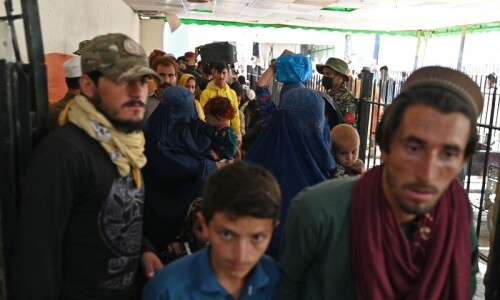
ISLAMABAD: The Supreme Court was approached on Wednesday to declare the caretaker government’s decision of mass deportation of Afghans as illegal, unconstitutional and against the fundamental rights.
Filed through Advocate Umer Ijaz Gilani, a joint petition moved on behalf of Farhatullah Babar, Senator Mushtaq Ahmed, Amina Masood Janjua, Mohsin Dawar, Mohammad Jibran Nasir, Syed Muaz Shah, Pastor Ghazala Parveen, Imaan Zainab Mazari, Ahmad Shabbar, Advocate Imran Shafiq, Luke Victor, Sijal Shafiq, and Rohail Kasi, pleaded before the apex court to restrain the federal government and state institutions from detaining, forcefully deporting, or otherwise harassing anyone who possesses a PoR (proof of residence), ACC (Afghan Citizen Card), asylum-seeker application issued by UNHCR or pre-screening slip issued by its partners SHARP and SEHAR.
The petition also sought that a direction that the federal government should not detain, forcefully deport, or otherwise harass anyone who was born in Pakistan and has a claim to birthright citizenship in accordance with Section 4 of the Citizenship Act, 1951, and the ruling of the Islamabad High Court in the 2021 Hafiz Hamdullah Saboor case.
Petition assails govt’s failure to distinguish between birthright citizens and undocumented immigrants
The petition contended that the federal government should also be asked to permit UNHCR and its partner organisations to register and expeditiously process and decide all the asylum-seeking applications filed by foreigners presently residing in Pakistan.
The court should also order the federal government to coordinate with all the relevant federal and provincial law enforcement agencies to secure the fundamental rights of all persons currently in Pakistan, the petition said.
The petition alleged that the government’s policy has failed to provide any mechanism to distinguish between birthright citizen and illegal immigrants.
Thus it violates the ruling of Pakistan’s superior court in the Hafiz Hamdullah Saboor case.
Moreover, the principle of non-refoulement suggests that a person should never be expatriated to a state where he or she faces the risk of political persecution. Jurists consider this principle to have attained the status of international customary law.
The petition contended that the policy of deporting the refugees violated the principles incorporated in Article 2A of the Constitution. Besides, the policy also fails to take into account the fact that many of the persons being deported or made liable to deportation may be doubly marginalised due to factors like ethnicity, religion, gender, etc.
The petitioner vehemently disagreed with the government’s view that all foreigners living in Pakistan without a valid visa were liable for deportation. This simplistic view of “illegal immigrants” neglects the fact that many of these so-called “illegal” and “undocumented” refugees were actually born in this country and, as per Section 4 of the Citizenship Act, 1951, have a solid claim to birthright citizenship.
The petition argued that the reason they remain without documents is that the government is unwilling to issue them, despite the law and court judgements in their favour.
Published in Dawn, November 2nd, 2023