Pakistan needs $340bn to meet climate challenges, says FM Akhtar


 0
0


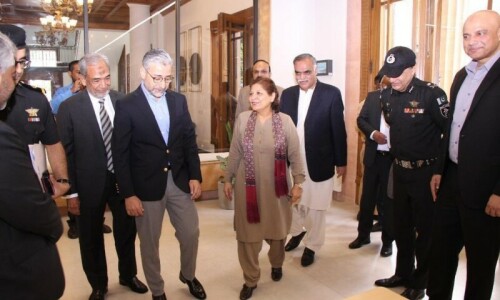
KARACHI: Caretaker Finance Minister Dr Shamshad Akhtar said on Wednesday Pakistan is facing a trade-off between raising climate finance and development finance.
“I think we need to be conscious that getting money is a big issue that we face in addressing the climate agenda,” she said, noting that seeking money for climate finance undercuts other development finance requirements.
Speaking at the second Pakistan Climate Conference organised by the Overseas Investors Chamber of Commerce and Industry (OICCI), Dr Akhtar said the best recourse for Pakistan will be to use its “best of the best firms” to attract institutional investors’ financing for bridging a “substantial” gap.
The country needs an estimated investment of $340 billion to address climate and development challenges between 2023 and 2030. The amount is equivalent to 10 per cent of the cumulative GDP during the same period, even though the country is responsible for less than 1pc of the world’s planet-warming gases.
The total cost of implementing Pakistan’s nationally determined contribution (NDC) — which is a self-defined national climate pledge under the Paris Agreement reflecting what Islamabad will do to help meet the global climate goals — is projected to be nearly $200bn by 2030.
Currently, only $39bn in public finance and $9bn through public-private partnerships is expected for both climate mitigation and adaptation efforts over the coming decade, she said.
Pakistan has carried out a few green finance initiatives such as the dollar-denominated green Eurobonds announced by the Water and Power Development Authority (Wapda). “We could’ve done another one, but given the issues surrounding the sovereign, I think we’d have to pay a very high cost for an international bond issuance,” she said.
“So I have, on behalf of the government, made a decision not to go for that,” she said, noting that she’d prefer raising funding from the platform of the Pakistan Stock Exchange (PSX).
The government is planning to float “some of government securities” and different instruments, including Islamic finance and green finance issues, through the PSX.
Legal amendments have already been made, she said, and the cabinet has ratified the changes approved by the Economic Coordination Committee. “If we can remain on course, which is always a challenge given what’s going on within Pakistan, we should be able to bring at least one issue of Sukuk,” she said, adding that the issue will have a “green element” to it.
Dr Akhtar noted that climate vulnerability and sovereign debt constitute “a very important element” in the dialogue taking place within the international financial architecture.
Pakistan has been classified as one of the countries vulnerable to climate change. At the same time, it is classified as a debt-distressed country because its marginal cost of borrowing is at a “very high rate” with almost 75pc of revenues being used for paying for loans and interest.
“Despite global sovereign roundtables to look at the resolution of the debt crisis, there hasn’t been a major breakthrough, except for the countries that have declared debt defaults. But it has its own consequences and complications and, as you know, that freezes the inflows,” she said, adding emphatically that a default was “not an option” for Pakistan.
Published in Dawn, November 2nd, 2023