THOUGH religious schools have been part of the social fabric of the subcontinent — and indeed the larger Muslim world — for centuries, madressahs took on a geopolitical character in the 1980s in Pakistan, as many became recruiting centres for the Afghan ‘jihad’.
There has been no looking back since then where the mushrooming of seminaries is concerned, even if the state’s fervour for transnational ‘jihad’ has cooled.
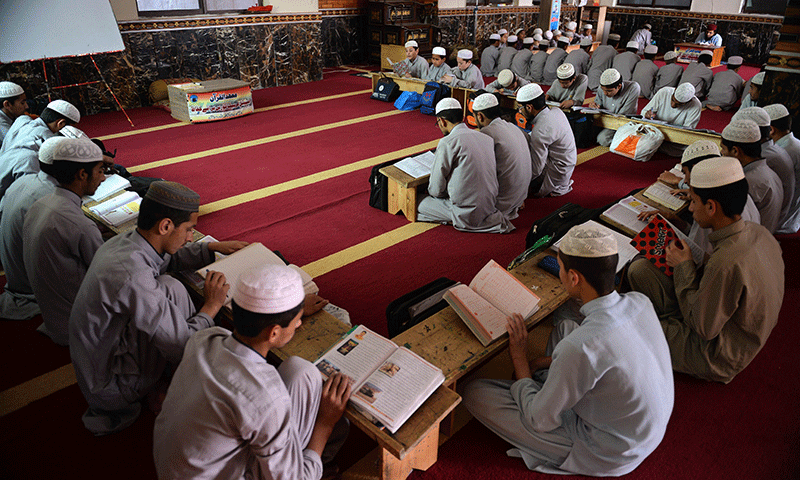
Today, tens of thousands of religious schools exist in Pakistan — 35,000 as per official figures — in which around 3m pupils are enrolled. And while many such institutions do not promote militancy and extremism, a significant number do.
The Lal Masjid debacle of 2007, and the subsequent reign of terror unleashed by the banned TTP, are two major examples of the cleric-madressah nexus violently defying the state’s writ. Sectarian terrorism is another manifestation of the problem.
Madressahs flowered under the watchful eye of one military strongman, Ziaul Haq; then, another general, Pervez Musharraf, took up the gauntlet to ‘reform’ madressahs, partly at the prodding of the West to tackle the ‘war on terror’.
Many madressah reform initiatives have come and gone since the Musharraf era, with the state unable to address the problem in a progressive manner. In the latest development, over Rs1.2bn have been earmarked for the Directorate General of Religious Education, overseen by the federal education ministry, that will register and regulate seminaries.
Registration is a positive step, but curriculum reform is needed as well, not only to excise sectarian and hate material from madressah courses, but also to equip seminarians with the skills that will enable them to find gainful employment once they graduate.
With millions of students studying in seminaries, and thousands graduating every year, one must ask how these madressah alumni will be absorbed by society. After all, the country only needs a certain number of clerics; where will the rest go?
In the worst-case scenario, they may be attracted to militancy or remain jobless. That is why it is important to teach marketable vocational skills in madressahs, so that seminarians can join the labour market, and contribute to the economy.
Of course, many in the clergy have always opposed and will continue to resist madressah reform as they think the state is encroaching on their ‘turf’. Yet the state must press on with the reform project not only to address the threat of growing extremism, but also to add qualified individuals to the labour market.
Many low-income parents send their wards to madressahs so that they will be fed and have free lodging. This can be addressed by improving the public education system — a long-term project — and offering free school nutrition programmes. Ignoring the ever-expanding growth of madressahs is a recipe for continuing societal disorder.
Published in Dawn, October 28th, 2023