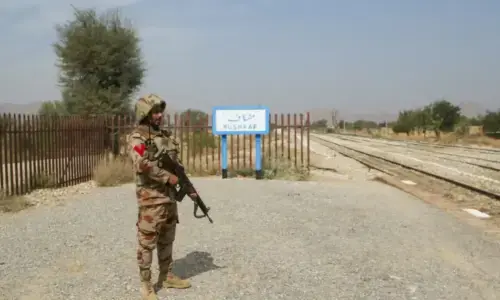
NIAMEY: UN peacekeepers, ordered to leave Mali by the country’s leaders, have been forced to rush their withdrawal, destroy equipment left behind and risk their lives on the road out.
Following a coup in 2020 the new military rulers in June ordered the peacekeepers out, proclaiming the “failure” of their mission and denouncing its alleged “instrumentalisation” of the human rights issue.
The following is an overview of this large-scale and risky operation, which brings to an end 10 years of efforts to try to stabilise a country plagued by jihadism and a range of other crises.
The United Nations Multidimensional Integrated Stabilisation Mission in Mali (MINUSMA), whose strength has hovered around 15,000 soldiers and police officers, has seen 180 of its members killed.
According to the latest update from the force, issued on Friday, 5,817 MINUSMA staff have left the force as of this week.
The original plan was for the peacekeeping force to have withdrawn from the West African nation by the end of the year, but already the UN troops have been leaving their compounds one after another, with the first withdrawals as early as July.
The MINUSMA withdrawal has exacerbated rivalries between armed groups present in the north of the country and the Malian state.
These groups do not want the UN camps handed back to the Malian army, saying such a move would contravene ceasefire and peace deals struck with Bamako in 2014 and 2015.
However, the army is pushing to take back control of the evacuated camps.
The predominantly Tuareg separatist groups who oppose the army have resumed hostilities against it.
The Al Qaeda-linked Support Group for Islam and Muslims (GSIM) has also stepped up attacks against the military.
That means that MINUSMA’s pull-out is all the more perilous, taking place against the background of this renewal of hostilities — and on what are perceived to be restrictions imposed by the authorities on its ability to manoeuvre.
Peacekeepers attacked
After vacating five camps since August, MINUSMA completed its “accelerated withdrawal” from Tessalit, in the northern Kidal region, on Sunday.
It did so, it said, in an “extremely tense and degraded” security context that “endangered the lives of its personnel”. In the days running up to the pull-out, shots were fired at its cargo aircraft and at its positions.
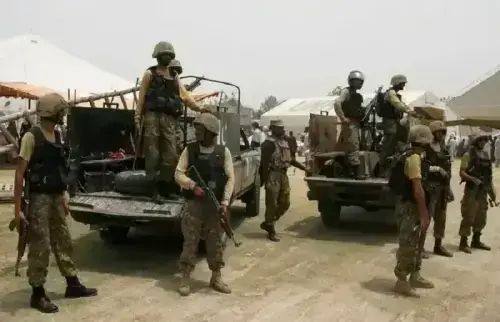
Part of the contingent, mainly Chadian, left by plane. But the rest were forced to travel overland to Gao, through more than 500 kilometres of desert, under constant threat from armed groups. The withdrawal from Aguelhok the following day happened under similar conditions, and the authorities did not give clearance for flights.
According to MINUSMA, the withdrawing convoys were attacked by explosive devices, resulting in injuries. The GSIM claimed responsibility.
And on Thursday, a logistics convoy travelling from Ansongo to Labbezanga in the Gao region came under fire. Three civilian truck drivers were injured, one of them seriously, said MINUSMA.
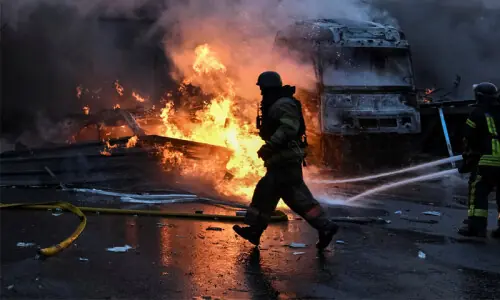
The UN peacekeeping force says it has had to destroy or decommission equipment such as vehicles, ammunition and generators that it was unable to take away, in accordance with UN rules.
Published in Dawn, October 28th, 2023