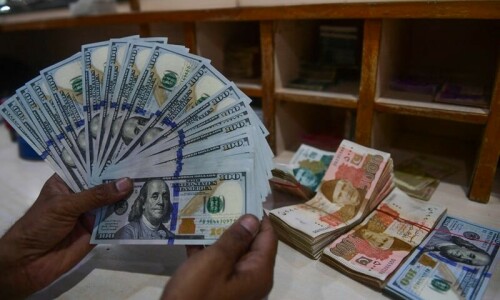
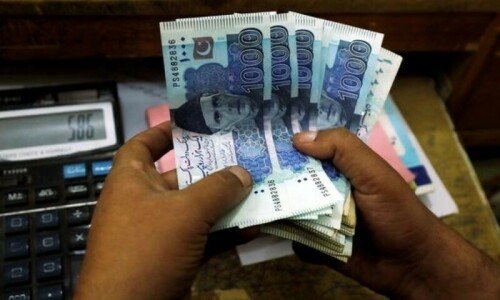
Dollar snaps 28-session losing streak

KARACHI: The winning streak of the rupee came to a halt on Tuesday after lasting for 28 consecutive sessions.
Official data showed the local currency lost 0.07 per cent of its value against the dollar from a day ago to close at 277.03.
Speaking to Dawn, Arif Habib Ltd Head of Research Tahir Abbas said higher demand for the greenback to make upcoming foreign payments put pressure on dollar supplies in the interbank market, leading to a slight erosion in the rupee’s newfound strength.
The overall gain in the rupee’s value since Sept 5 has been 10.9pc. The impact since the beginning of October alone has been 3.8pc.
Outcome of upcoming IMF review will set future direction
Mr Abbas said the real effective exchange rate — an index that’s often used as a proxy for the strength of a currency relative to a basket of other currencies — is currently hovering around the 100 mark. Its presence in the vicinity of 100 suggests the rupee is “fairly valued” at the moment, he said. “I see its consolidation in the 275-280 range,” he added.
The future direction of the exchange rate largely depends on the upcoming review of the loan programme by the International Monetary Fund (IMF) in November, which is a prerequisite for the disbursement of the next tranche necessary to maintain the country’s balance of payments.
A favourable review by the IMF will pave the way for foreign exchange inflows from other multilaterals. In addition, upcoming data on export proceeds and overseas workers’ remittances will also help determine the exchange rate direction, he said.
The month-long winning streak of the rupee follows concerted efforts by the civil and military authorities to curb the smuggling and hoarding of dollars.
To bring the dollar trading under a stricter regime, the State Bank of Pakistan (SBP) allowed commercial banks to establish wholly owned exchange companies to cater to the “legitimate” foreign exchange needs of the general public.
Earlier, commercial banks weren’t allowed to conduct foreign exchange business with the general public. Exchange companies fulfilled the foreign exchange needs of people at the retail level while banks handled the dollar-denominated transactions in the interbank market.
Second-tier exchange companies were routinely accused of selling dollars at higher than the going open market rate if the interested buyers lacked a legally appropriate reason for the purchase of foreign exchange, needed more than the allowed limit or couldn’t furnish the required documents like CNIC.
The SBP has also directed that various types of existing exchange companies and their franchisees be consolidated and transformed into a single category of exchange companies. The minimum capital requirement for exchange companies was also increased from Rs200 million to Rs500m.
Even though the SBP officially maintains that the day-to-day decline in the dollar rate is the outcome of supply and demand, some bankers accuse the central bank of setting the daily dollar rate for banks to follow.
They say the SBP is the biggest buyer in the banking market. It purchases foreign exchange through forward booking by offering a slightly higher rate than the ready rate despite the dollar having declined each day — a phenomenon that’s heavily contributed to the steady decline in the value of the greenback.
Published in Dawn, October 18th, 2023