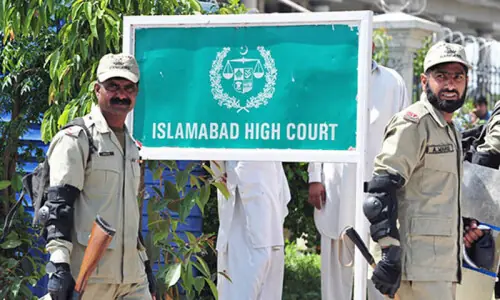
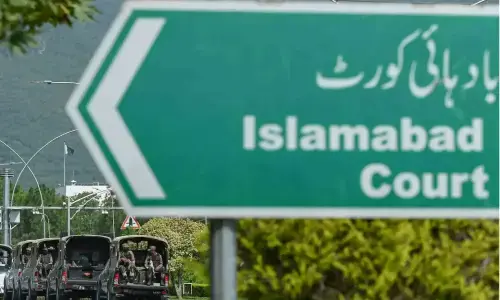
THE legal debate over the controversial Supreme Court (Practice and Procedure) Act of 2023 is over — for now. Through a 10-5 split verdict, a full court bench of the Supreme Court has upheld parliament’s prerogative to regulate, through simple legislation, the powers of the chief justice, and to enforce procedural changes in the Supreme Court’s decision-making process regarding how cases are to be taken up and who is to be assigned to the benches. The court has also upheld as constitutional most provisions of the Practice and Procedure law, but struck down a subsection that had granted the right to appeal past cases already decided under Article 184(3). This retrospective right to appeal had been seen as a lifeline for PML-N supremo Nawaz Sharif and the Istehkam-i-Pakistan Party’s Jahangir Tareen, who both stand disqualified from holding public office under past cases decided by the Supreme Court. The decision has put a cloud over their chances to contest the next general election.
The political implications aside, it is encouraging to note that the Supreme Court showed considerable deference to parliament and its legislative powers while it examined the Practice and Procedure law. Though some of the justices clearly had valid concerns regarding the intent of the law and the context in which it was passed, it seemed that for a change the Supreme Court was making an effort to accord due consideration to parliament as an equal institution. The temptation to veto what many saw and continue to see as an infringement of the judiciary’s domain must have been strong, but Chief Justice Qazi Faez Isa repeatedly urged his fellow judges to overcome the court’s tendency to hold the legislature in suspicion. The result has been a graceful concession from the judiciary to parliament. It is hoped that this balance between these two branches of the state will be maintained going forward.
On a similar note, it is commendable that the chief justice has allowed the powers vested in his office to be taken away for the greater benefit. While the legal community had long agreed that the chief justice’s suo motu powers must be regulated and that bench formation should be done in a more transparent manner, no chief justice ever relinquished control over the institution before Chief Justice Isa. In this, his selflessness must be appreciated. It also bears noting that, with this decision, the bar self-imposed by some of the Supreme Court judges on taking up Article 184(3) cases now stands removed. It is therefore expected that the court will now turn its attention to the several major public interest petitions pending before it, most important among which are petitions against the military trials of civilians and those concerning the conduct of elections within the constitutional scheme.
Published in Dawn, October 13th, 2023