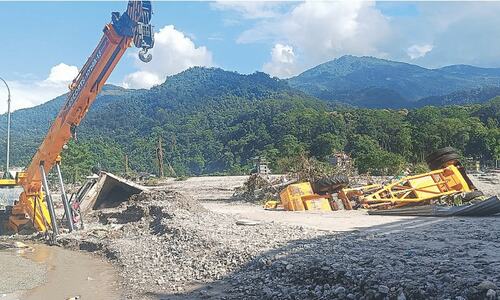
At least 77 people are confirmed dead in the floods that hit India’s northeast, authorities said on Sunday, with destroyed roads and bridges leaving thousands more still cut off despite waters receding.
Violent torrents struck Sikkim state on Wednesday after a high-altitude glacial lake suddenly burst.
Scientists warn that similar disasters will become an increasing danger across the Himalayas as global temperatures rise and ice melts, spurred by climate change.
“A total of 29 bodies have been retrieved from different parts of Sikkim,” state relief commissioner Anilraj Rai told AFP by phone.
In neighbouring West Bengal state, Jalpaiguri district police told AFP that another 48 bodies had been recovered.
More than 100 people are still missing, according to official figures. Water levels along the Teesta River “returned to normal” four days after the floods hit, an official from Sikkim’s state disaster control room told AFP.
The office said more than 2,500 people stranded in the floods had been rescued.
But evacuations have been complicated by the destruction of roads, bridges and telephone lines across much of Sikkim.
Another 3,000 people were still stranded in several relief camps in the state’s north with airlift rescues delayed by bad weather, the office said.
More than 1,200 houses were damaged by the floods, according to the state government.
Loose ordnance
Among the dead were eight Indian army soldiers posted to Sikkim, which sits on India’s remote frontiers with Nepal and China and boasts a sizeable military presence.
India’s defence ministry said in a Saturday statement that the floods had washed away “firearms and explosives” from military camps.
Local media reports on Friday said that two people had been killed and four others injured by a mortar shell that exploded while flowing through the flood waters in West Bengal.
The water surge came after intense rainfall burst the high-altitude Lhonak Lake, which sits at the base of a glacier in peaks surrounding the world’s third-highest mountain, Kangchenjunga.
Water powered downstream, adding to a river already swollen by monsoon rains, damaging a dam and sweeping away houses.
Himalayan glaciers are melting faster than ever due to climate change, exposing communities to unpredictable and costly disasters, according to the International Centre for Integrated Mountain Development (ICIMOD) research group.
“The root cause is climate change,” ICIMOD’s Arun Bhakta Shrestha told AFP on Thursday.
“Similar glacial lake outbursts flood events are very likely,” he said.
Earth’s average surface temperature has risen nearly 1.2 degrees Celsius since pre-industrial times but high-mountain regions around the world have warmed at twice that pace, climate scientists say.