At least 14 dead, 102 missing in India glacial lake burst



Indian rescue teams searched on Thursday for 102 people missing after a devastating flash flood triggered by a high-altitude glacial lake burst killed at least 14, officials said.
Violent flooding from glacier lakes dammed by loose rock has become more frequent as global temperatures rise and ice melts, with climate scientists warning it poses an increasing danger across the wider Himalayan mountain range.
“The number of human lives lost is 14 so far, and the number of missing is 102,” Prabhakar Rai, director of the Sikkim state disaster management authority, told AFP a day after a wall of water rushed down the mountainous valley in northeastern India.
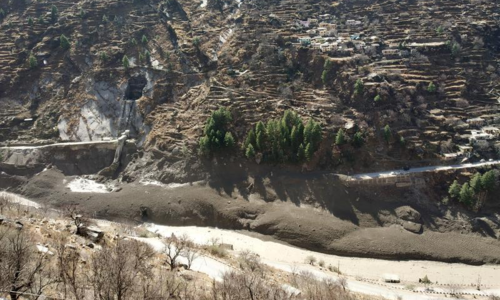
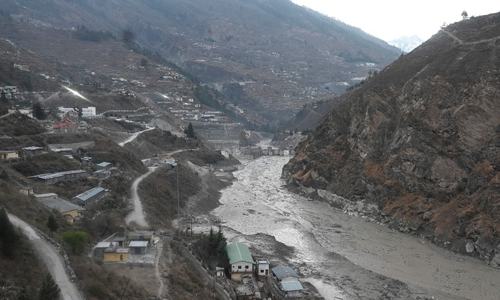
Authorities said roads had been “severely” damaged and 14 bridges had been washed away.
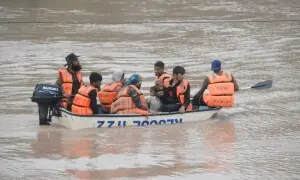
Rescuers were battling to help those hit by the flood, with communications cut across large areas, and 25 relief camps set up for those forced to flee their homes.
“Floodwaters have caused havoc in four districts of the state, sweeping away people, roads, bridges,” Himanshu Tiwari, an Indian Army spokesman, told AFP.
Twenty-two soldiers are among the missing, the army said. One previously missing soldier was rescued.
The army was working to reestablish telephone connections and provide “medical aid to tourists and locals stranded”, it said in a statement.
The water surge came after intense rainfall burst the high-altitude Lhonak Lake, which sits at the base of a glacier in peaks surrounding the world’s third-highest mountain, Kangchenjunga.
Himalayan glaciers are melting faster than ever due to climate change, exposing communities to unpredictable and costly disasters, according to the International Centre for Integrated Mountain Development (ICIMOD) research group.
‘Serious destruction’
Water powered downstream, adding to a river already swollen by monsoon rains, damaging a dam, sweeping away houses and bridges, and causing “serious destruction”, the Sikkim state government said.
Damage was recorded more than 120 kilometres (75 miles) downstream, and Prime Minister Narendra Modi has promised “all possible support” for those affected.
Lhonak Lake shrunk by nearly two-thirds in size, an area roughly equivalent to about 150 football pitches (105 hectares), satellite photographs released by the Indian Space Research Organisation showed.
“Intense rain has led to this catastrophic situation in Sikkim where the rain has triggered a glacial lake outburst flood and damaged a dam, and caused loss of life,” said Miriam Jackson, a scientist specialising in ice who monitors Himalayan regions with the Nepal-based ICIMOD.
“We observe that such extreme events increase in frequency as the climate continues to warm and takes us into unknown territory.”
Earth’s average surface temperature has risen nearly 1.2 degrees Celsius since pre-industrial times but high-mountain regions around the world have warmed at twice that pace, climate scientists say.
Sikkim is close to India’s border with Nepal and China and boasts a sizeable military presence.
India has been wary of China’s growing military assertiveness and their 3,500-kilometre shared frontier has been a perennial source of tension, with parts of Sikkim claimed by Beijing.