World’s oldest wooden structure discovered in Zambia

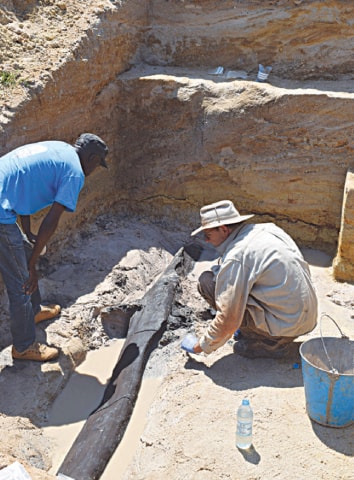
PARIS: Archaeologists said on Wednesday they have unearthed the oldest wooden structure ever discovered, dating from nearly half a million years ago, which suggests that our ancestors may have been more advanced than previously thought.
The exceptionally well-preserved wooden structure was found at Kalambo Falls in the north of Zambia near the border with Tanzania. It dates back at least 476,000 years, well before the evolution of Homo sapiens, according to a study describing the find in the journal Nature.
The wood bears cut-marks showing that stone tools were used to join two large logs to make the structure, which is believed to be a platform, walkway or raised dwelling to keep our relatives above the water.
A collection of wooden tools, including a wedge and a digging stick, were also discovered at the site.
It dates back at least 476,000 years before the evolution of Homo Sapiens, says study
The ancestors of humans were already known to use wood at this time, but for limited purposes such as starting a fire or hunting.
Larry Barham, an archaeologist at the UK’s University of Liverpool and the study’s lead author, said that to his knowledge the previous record-holder for oldest wooden structure dated back around 9,000 years.
Barham said the structure was a “chance discovery” made in 2019 while excavating at the site located on the banks of the Kalambo River, above 770-foot waterfall.
Discoveries involving such ancient wood are rare, because it tends to rot leaving behind little trace for the historical record.
But the high level of water at Kalambo Falls is believed to have preserved the structure over the centuries.
‘Imagination and skills’
Excavations at the Kalambo site in the 1950s and 1960s unearthed some wood, but it was not able to be accurately dated.
However, this time around, the researchers used a new method called luminescence dating, which determines age by measuring the last time minerals were exposed to sunlight.
This revealed that the structure was much older than the researchers had thought, dating back at least 476,000 years.
The earliest evidence of Homo sapiens is from around 300,000 years ago. But fossils of human relative Homo heidelbergensis, thought to have lived between 700,000 to 200,000 years ago, have been found in the region, Barham said.
The discovery of the wooden structure “changed how I thought about these people”, Barham added.
“They transformed their surroundings to make life easier, even if it was only by making a platform to sit on by the river to do their daily chores,” he said.
“They used their intelligence, imagination and skills to create something they’d never seen before, something that had never previously existed.”
Published in Dawn, September 21st, 2023