0
0
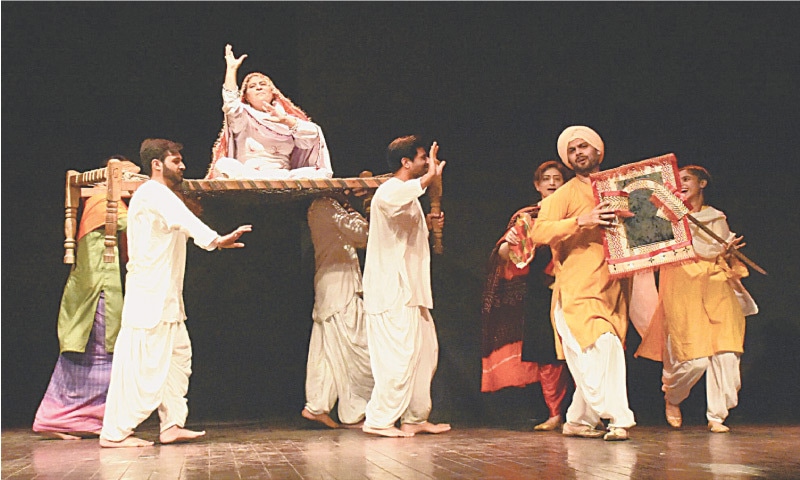

KARACHI: In William Shakespeare’s King Lear, the playwright uses a great technique to drive the message of ‘learning through ill judgment’ home. The king gains sanity after losing his marbles and the character of Gloucester experience spiritual awakening after going blind. Lahore’s renowned Ajoka Theatre’s presentation Anhi Ma Da Sufna (a blind woman’s dream) at the ongoing Pakistan Theatre Festival on Monday evening may not have dealt with the same symbol but had a similar message of how important it is to learn from circumstances that aren’t always in our control.
The Punjabi play focuses on the partition of India and the way it cleaved families from either side of the Punjab province. It is a subject on which a lot has been written both in verse and in prose. Therefore, to present it dramatically without succumbing to clichéd motifs is a challenge. Ajoka does well on that count. By using live music, dance moves and thoughtful lighting, the playwright Shahid Nadeem makes sure that the dramatic element of the story is not upstaged by the sentimentality of the subject matter.
The character of Ma in the play is the heart of the story. She was born in a village which is now Pakistan but had to shift to India after independence. When the curtains go up, she has lost her ability to see. She has this undying urge to visit her ancestral village, a goal which is becoming increasingly difficult because of the war that has taken place between the two countries and other political hurdles.
Then there is the dyer, Rangsaaz, on Pakistan side of the border who, too, has a past which is linked with pre-partition Punjab and receives an invitation to attend a wedding of a blood relation. He gets excited, but, again, it’s not easy because of the diplomatic obstacles.
This is an engaging plot. The makers of the drama do a fine job by blurring the line between what the characters are thinking and doing, the real and the imaginary. It is a nice ploy to underline difficult things.
The actors (Naseem Abbas, Usman, Razia, Malik Qaiser, Usman Zia, Rizwan Riaz) play their part in a thoughtful manner as well because with a rural setting in a play written in the Punjabi language, the performers can get louder than required on stage; their voices commensurate with their lines.
Published in Dawn, September 20th, 2023