After the floods


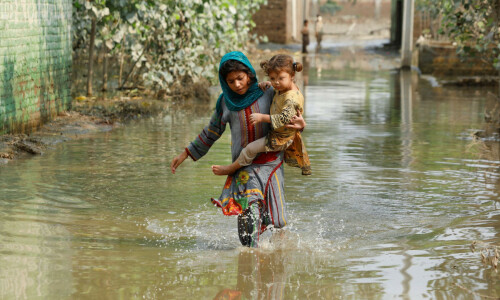
PAKISTAN faced its worst floods in 2022. More than 33 million people were affected. According to a World Bank report, cities in lower-income countries contribute around 14 per cent to global carbon emissions yet they are more vulnerable to climate-induced disasters.
Irrespective of infrastructural changes carried out to upscale the discourse on climate change in Pakistan, we remain at the edge when it comes to rehabilitation after any crisis. The 2022 floods and the recent expected horror of Cyclone Biparjoy made us proactive in planning but sustaining rehabilitation efforts remains a challenge.
The government initiated multiple relief programmes for the flood-affected, including multipurpose cash assistance, relief items for dignity, and makeshift shelters. The onset of any emergency requires an immediate response including the provision of basic items which supports the affected population.
Recovery and rehabilitation of people struck by disaster is a crucial component of disaster management ideology. However, the rehabilitation process is and has always been an afterthought, leaving many facing long-term social and economic instability. Disaster management requires financial and social integration, the absence of which can lead to bigger trials for public officeholders who work for the people.
The Pakistan Disaster Management Authority can only implement its ideas given the requisite resources. Expanding the latter requires both intention and liaising with partners at all levels. The 2022 floods (and those in 2010) witnessed many CSOs stepping up to voluntarily rebuild damaged infrastructure, but a year later there are questions to ponder. The preplanning for Biparjoy was immaculate; however, had the cyclone hit Pakistan with the expected intensity, the situation would have been different.
The sustainability of our response after a disaster needs a complete study of resources and action, without which disaster management is incomplete. Disaster management includes both an immediate response and long-term recovery — from infrastructural rehabilitation to emotional well-being — of the community. In order to reap long-term results, we require more actors (beyond those with political mandates) to implement the plans.
The public-private partnership model may sound clichéd, but in the absence of one, it would be challenging to expedite rehabilitation after a calamity. Public-private partnership in times of crises can open new pathways for collaboration and learning.
While this kind of partnership has existed since the earliest of times, we may like to reconsider building sustainable solutions, instead of focusing solely on immediate response-based service deliveries.
NGOs provide huge funding opportunities, however, public officeholders need to tap into these opportunities to create something beyond a public dialogue. These funds need to be redirected towards the development of early warning facilities for the larger good.
Disaster preparedness in communities remains a challenge.
The response mechanism needs the inclusion of a gendered approach to address the disproportionality with which these climate disasters affect women and girls. Constructing public latrines in villages has helped, but are these accessible to pregnant women and people with disabilities?
Across Sindh and Balochistan these remain widely inaccessible to them. The inclusion of PWDs, women and children in response and rehabilitation strategies will improve their quality of life.
Disaster preparedness in communities remains a challenge. Irrespective of radio and media campaigns, most of our population remains unaware of immediate responses to a disaster. Perhaps the inclusion of disaster preparedness in the curriculum at an early level may impact the knowledge base of many, but we need to have a plan for that part of the population that does not have access to schools.
Radio alone is not enough to prepare communities. In the remote peripheries, where people are already living at the edge, disaster preparedness is a challenge that public officeholders must be aware of. These challenges can only be eased with structural changes to the system.
The events of the 2022 floods will likely become a document that no one will care to read till another climate-induced disaster hits Pakistan. Disaster management is not a political mandate; it’s a universal need which requires unity of officeholders who must not politicise it for personal benefit.
Merely adding to hefty reports, which are unlikely to be read and acted upon, will not serve the purpose. However, an enabling approach that can serve communities in the long term and make them better prepared and more resilient when disaster revisits is the only workable solution.
The writer is an advocacy, media and communications officer for humanitarian response at Oxfam in Pakistan.
Twitter: @ToobaNiazi
Published in Dawn, July 18th, 2023