0
0

KARACHI: The law against the business and practices of private money-lending and advancing loans on interest has come into effect in Sindh as the governor gave assent to the ‘The Sindh Prohibition of Interest on Private Loans Act,’ 2023.
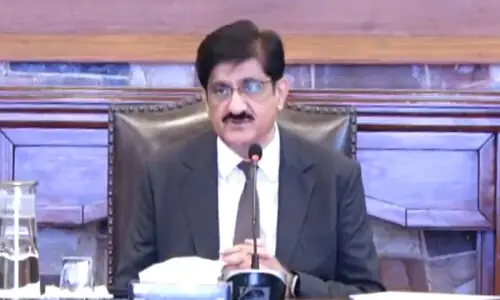
Chief Minister’s Law Adviser Barrister Murtaza Wahab told Dawn on Sunday that the bill, earlier passed by the provincial assembly, had been approved by the governor, adding that now the cases would be registered against those who gave loans on interest through private means.
Mr Wahab, who is also provincial government’s spokesperson and Karachi Mayor, said the implementation of law would make it possible to prosecute those who collected interest by taking advantage of people’s compulsion.
A man committed suicide in Rawalpindi a few days ago after being fed up with threats issued by online lending companies. The incident prompted a crackdown against online lending companies by the Federal Investigation Agency.
Barrister Wahab said the Sindh Prohibition of Interest on Private Loans Act, 2023, envisaged a 10-year jail term and a fine of Rs1 million for those indulging in such practices.
According to the preamble of the new law, injunctions of Islam as laid down in the Holy Quran and Sunnah have explicitly and unequivocally prohibited charging interest on loans.
It states that it is expedient to make a comprehensive legislation on the subject, for covering all the aspects of the mischief of private money lending by prohibiting the business and practices of private money lending and advancing loans and transactions in Sindh, and to provide for matters ancillary thereto.
As per the law, interest includes any amount, big or small, over the principal, in a contract of loan or debt, regardless of whether the loan is taken for purpose of consumption or for some production activity, whether the same is charged or sought to be recovered specifically by way of interest or otherwise, or found so to be recoverable by a competent court.
Section 3(1) of the newly enacted law prohibits that no moneylender, either individually or in a group of persons, shall lend money for cars or any other purpose or advance loan to any person for the purpose of receiving interest thereon, nor shall carry on an interest-based transaction in Sindh.
Whoever contravenes these provisions, either directly or indirectly, shall be punished with imprisonment of either description which may extend to 10 years, but shall not be less than three years, and shall also be liable to fine not exceeding Rs1m.
The same penalty applies to those who intentionally and wilfully abet, engage, assist or aid the moneylender.
The law states that a ‘Justice of Peace’ shall, within three days of the receipt of any application or complaint regarding the commission of an offence, order the local police to register a case against the person or group of persons.
While, no court less than a judicial magistrate of the First Class shall try an offence under this law.
If the penalty imposed on a moneylender, or the amount ordered to be returned is not paid, the court may order recovery of the amount by selling the assets belonging to such a person.
Published in Dawn, July 17th, 2023