WASHINGTON: The International Monetary Fund (IMF) has said that Pakistan’s new $3 billion loan programme would anchor the country’s immediate efforts to stabilise the economy and fulfil the current balance of payments needs.
Earlier this week, the IMF executive board approved a nine-month standby arrangement (SBA) with Pakistan “to support its economic stabilisation programme”.
At a press briefing on Thursday, IMF spokesperson Julie Kozack said the SBA came at a “challenging juncture” but would be useful for the country.
“While it is a relatively short programme, it provides time for Pakistan to implement policies critical to strengthening its domestic external economic situation, thereby supporting sustainability,” Ms Kozack said.
PM calls Fund chief, thanks her for getting $3bn bailout approved
She explained that on July 12, the IMF board approved a nine-month standby arrangement for Pakistan in the amount of $3bn, aimed at supporting the authority’s economic stabilisation plan and economic stabilisation programme. The immediate disbursement reached about $1.2bn.
“The new programme will anchor the authorities’ immediate efforts to stabilise the economy,” Ms Kozack said. “It would also provide a framework for financing from multilateral and bilateral partners to support Pakistan’s policies.”
The IMF official, however, warned that “steadfast policy implementation is critical in the period ahead. And for the success of the programme and, of course, ultimately, to aid and support the people of Pakistan.”
Dispelling the impression that the programme would be tough on the poor, the IMF official said that it would provide “due protection for the most vulnerable”.
Responding to the question of why the Fund signed a short programme with Pakistan, Ms Kozack said: “The standby [arrangement] is aimed at supporting the authority’s immediate effort to stabilise the economy and to ensure that the current balance of payments need is filled.”
But she emphasised that resolving Pakistan’s structural challenges would require continued reforms over the medium term to underpin the needed economic transformations, strengthen inclusive growth prospects, and create an environment conducive to renewed private capital inflows.
Ms Kozack assured Pakistani authorities that “we at the IMF always stand ready to work with Pakistan and the Pakistani government on these efforts to restore sustainability and economic stability.”
In an earlier statement, US Secretary of State Antony Blinken also assured Pakistan that the United States would “stand by the Pakistani people during these hard times.” He too urged Pakistan to “continue working with the IMF towards macroeconomic reforms and sustainable economic recovery.”
The package had been on hold since December when the IMF refused to release a critical $1.1bn from the loan because of Islamabad’s lack of compliance with a 2019 agreement signed.
The release of $1.2bn on Thursday brought much-needed relief to Pakistan, which was seen to be on the brink of a default. But the agreement comes with strict conditions on spending and structural reforms that are likely to further increase economic hardship for many common people.
Pakistan has already taken several steps demanded by the IMF, including revising its 2023-24 budget and raising its policy rate to 22 per cent in recent weeks.
The IMF also persuaded Pakistan to raise about $1.34bn in new taxation and to make the central bank proactive to reduce inflation and maintain a foreign exchange framework.
The adjustments have already fuelled all-time high inflation of 38pc year-on-year in May, the highest in Asia. The IMF demands further reform in the energy sector, which has accumulated nearly $12.58bn in debt.
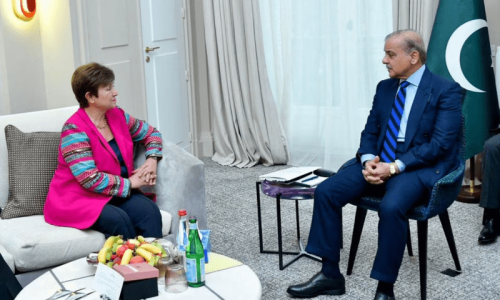
PM phones IMF chief
Meanwhile, Prime Minister Shehbaz Sharif telephoned IMF chief Kristalina Georgieva on Friday to thank her for her role in getting a $3bn bailout package for Pakistan as the Fund assured Islamabad the package would strengthen its efforts to stabilise the national economy and meet balance-of-payments requirements.
The premier appreciated Ms Georgieva for her leadership and professionalism and acknowledged that she felt for the poor and termed her support as invaluable, the Prime Minister’s Office said in a statement.
The IMF chief said Mr Sharif “built a very convincing case” and in the light of her continued engagement with the prime minister, she assured the IMF board that Pakistan would deliver on its commitments.
The premier reassured that he would not tolerate “an iota of violation of this agreement” with the IMF. “This government is here till August, after which an interim government will take over and he is confident that they will continue to fulfil the obligations,” he said.
After elections, if the people of Pakistan re-elect his government, he was committed to turning over the economy with the help of IMF and development partners, Mr Sharif said.
Published in Dawn, July 15th, 2023