THE SCO has the potential to become one of the world’s most prosperous and powerful economic and geopolitical blocs, considering its vast geographic scope and the large population of its member states. However, to achieve these goals, irritants between member states must be resolved in a satisfactory manner.
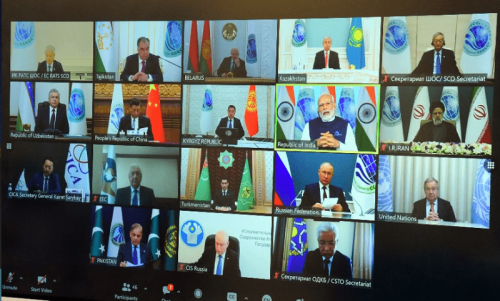
Clearly, as the virtual SCO Council of Heads of State summit, hosted by India on Tuesday showed, there are many miles to go before the bloc can achieve its full potential. Bilateral disputes overshadowed the promise of multilateral cooperation, with the host nation using the platform to take a swipe at geopolitical adversaries within the SCO.
Indian Prime Minister Narendra Modi’s thinly veiled critique of both Pakistan and China during his address was a reminder of the internal challenges that confront the bloc.
There was, of course, little hope that the SCO summit could have provided a platform for Pakistan-India dialogue on the sidelines. Bilawal Bhutto-Zardari’s frosty reception in Goa earlier in the year under the aegis of the SCO foreign ministers’ moot was a sign that the welcome for Shehbaz Sharif was unlikely to be any warmer.
Perhaps that is one reason why India chose to go virtual and avoid any personal interaction between Mr Sharif and Mr Modi, though there is also widespread conjecture that India opted to hold the summit online to avoid hosting Vladimir Putin.
Mr Modi sang a familiar tune, calling for an end to ‘cross-border terrorism’, while also targeting CPEC by saying that connectivity schemes should “respect sovereignty”, in an oblique reference to the megaproject’s passage through Gilgit-Baltistan.
PM Sharif paid Mr Modi back in the same coin, cautioning against the dangers of “violent ultra-nationalism” and criticising the use of terrorism for diplomatic point-scoring.
It is a rule of thumb that multilateral fora should not be used to settle bilateral scores. If anything, these bodies should provide a conducive atmosphere that can help resolve stubborn regional disputes.
Unfortunately, India’s current leadership has shown that both bilaterally and at multilateral platforms, it is not serious about engaging Pakistan in a dialogue for peace. Instead, the BJP regime is more interested in isolating this country by using familiar, tired tropes.
If this attitude persists, little will change where hostility in the subcontinent is concerned, and perhaps another generation will be condemned to live in perpetual confrontation. Terrorism, climate change, poverty and disease are all common problems that can be confronted bilaterally and through the SCO, if India chooses to shun its rigidity.
Where the SCO itself is concerned, it can be turned into a Eurasian behemoth driving growth in the entire region and the wider world. However, unless the irritants between its member states are resolved, it will remain but a talk shop, much like Saarc has become.
Published in Dawn, July 6th, 2023