Scholars urge Taliban to remove curbs on women

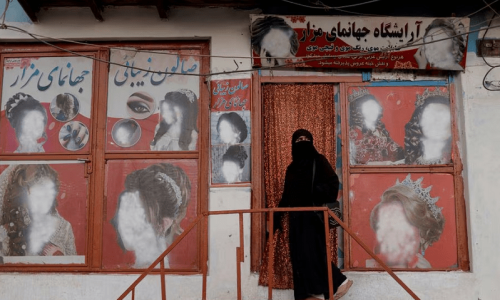
UNITED NATIONS: Religious scholars from Pakistan, Saudi Arabia, Qatar and Indonesia are trying to convince Afghanistan’s Taliban rulers that Islam does not ban women from going to school or work, says the UN mission chief in Afghanistan.
In an interview with UN News, UN Assistance Mission in Afghanistan’s (UNAMA) acting chief Markus Poztel said the United Nations should work as a “bridge builder” in a very complex setting where the needs were as great as the challenges.
The United Nations, he said, should focus on restoring and protecting basic rights in Afghanistan, particularly the rights of women and girls.
Asked if the UN had received cooperation from Islamic countries in helping you deliver its message to the Taliban, Mr Poztel said: “A delegation of the Organisation of Islamic Cooperation (OIC) came here and tried to convince the decision-makers in this country of the view that education is part of Islam.”
The delegation included scholars from Pakistan, Saudi Arabia, Qatar, and Indonesia, and during the earlier visit a woman was part of the scholars’ delegation.
“Islamic countries probably have better access and are probably more convincing in talking to the Taliban. We hope that in the end, all our efforts will bear fruit,” Mr Poztel said.
“So far to no avail, but they will come back,” said the UN official when asked if such visits have had a positive impact on the Taliban.
The UN report noted that when the Taliban surged back into power in August 2021, Afghanistan was virtually cut off from the rest of the world, and decisions by the de facto authorities to further restrict human rights had only deepened the country’s isolation.
Since then, as international funding has stalled amid skepticism about the Taliban’s return, the UN has been acting as the world’s “eyes and ears” in Afghanistan, the report added.
Mr Poztel told UN News “there is no middle ground” on the issue of women and girls’ education and that broader human rights and the decrees banning women’s participation in society “should be reversed as soon as possible”.
He noted that Afghanistan was still the world’s largest producer of opium but the Taliban rulers were trying to deal with the situation.
“We’ve recently seen a ban on poppy cultivation, production, and trafficking. Initial field reports suggest that there has been a decline in poppy cultivation, which we commend,” he said.
Published in Dawn, July 6th, 2023