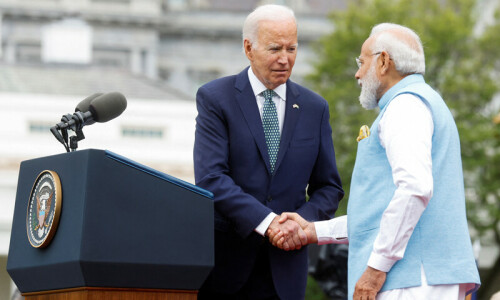
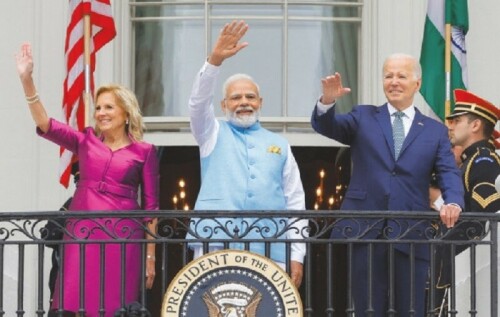
KICKING off his US visit with a yoga session on the north lawn of the United Nations, Indian Prime Minister Narendra Modi assumed the positions of a cobra, crocodile, and frog. Pakistanis watching the visit unfold last week probably hurled more animal slurs his way. But the visit should leave Pakistan introspective.
My compatriots have been incensed at the US-India joint statement calling on Pakistan to do more to counter terrorism, and inviting further FATF scrutiny of our efforts to counter terrorism financing. Similar statements with similar phrasing have been issued by four US administrations to smooth the course of the US-India bilateral relationship. It is the least of our worries.
Much has already been written to explain why Modi — once banned from entering the US due to his involvement in the anti-Muslim pogrom in Gujarat — is now feted as America’s great friend. The answer is always geopolitics: India, with its burgeoning population and robust economy, is in America’s eyes the only convincing counterpoint to China in Asia; there is no managing Beijing without befriending New Delhi.
And then there’s the Russia angle. With growing urgency to resolve the Ukraine conflict and weaken Russia sufficiently to prevent future such transgressions, Washington needs New Delhi to take a more critical stance vis-à-vis Moscow, historic defence ties notwithstanding.
When Great Games are underway, everyone starts to bend the rules. In the US case, that means choosing to largely ignore India’s horrific human rights record with regard to Kashmir and the Indian Muslim population, and the rapid erosion of India’s democratic culture in the form of press censorship and clampdowns on the political opposition.
Introspection is needed after Modi’s US visit.
So where does this leave Pakistan? We could cry foul at being told (yet again) to clamp down on home-grown militancy. But this is not a way to make friends and influence people (least of all China and Saudi Arabia, long-term allies who discreetly signalled to Pakistan in recent years that the strategy of maintaining state-sponsored ‘assets’ is no longer welcome).
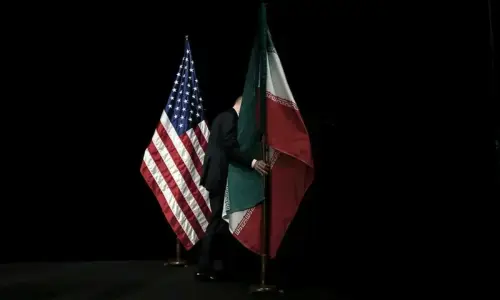
Here’s another option: we could initiate a serious rethink of our foreign policy. The major challenge for Islamabad arising out of Modi’s visit is the question of how to balance its ties with Washington and Beijing. We need to maintain our links with both these superpowers: we need the loan rollovers from Beijing, the IMF bailouts from the US. We need China’s infrastructure investments, and American IT innovations. We do not want to have to choose.
Arguably, the visit we should have obsessed over last week was that of US Secretary of State Antony Blinken to China. The trip aimed to ease tensions between the superpowers after the US shot down a Chinese spy plane in February. Some progress was made to stabilise ties and improve communication, but relations soured again when US President Joe Biden referred to China’s president as a “dictator”.
Could Pakistan add value to both its allies by playing a productive mediator? Unlikely given our current political meltdown, but these are questions we should be asking.
Another 21st-century reality highlighted by Modi’s visit is that unless you have something to offer the world, the world doesn’t care what happens to you. Our long-term strategy of negotiating under pressure has run its course. Rather than agonise over the impressive defence deals that New Delhi has struck with Washington, let’s consider what else makes India an attractive partner for the US.
Geopolitical might aside, Modi arrived in Washington with semi-conductor assembly and other manufacturing capacity, critical minerals, climate finance opportunities and an ambitious space programme.
For supporting the diversification of supply chains away from China and facilitating the global green transition, India is receiving the kind of inward investment that many will covet: not just hundreds of millions dollars into manufacturing facilities, but also an agreement to train 60,000 Indian engineers to boost India’s capacity to develop semiconductors.
Pakistan will be lost if it doesn’t marry economic policy (our vague premise of doing better on agriculture and IT) with foreign policy and geopolitical realities. Ultimately, it will have to reappraise the cost of premising its foreign policy on enmity with India.
Areas for cooperation — food and water security, climate adaptation and mitigation, supply chain integration, access to technology, and even regional stability — are proliferating and need to be explored (perhaps one day in a threesome with Washington too?). Without a more agile approach, Pakistan will only hasten its isolation.
The writer is a political and integrity risk analyst.
Twitter: @humayusuf
Published in Dawn, June 26th, 2023