0
0

LARKANA: Qambar-Shahdadkot – one of the few districts that were worst-hit by last year’s unprecedented rains and floods – is now facing an acute shortage of water.
Flows in canals and other irrigation channels had declined drastically leaving vast areas without water and badly affecting paddy cultivation process.
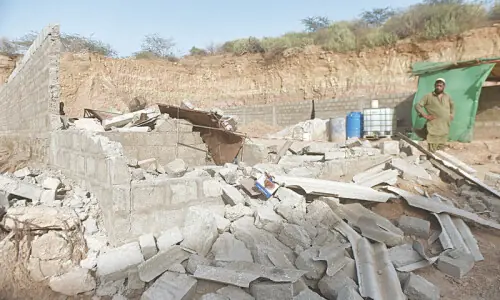
One of the main reasons leading to the adverse situation is stated to be the extensive damage caused to the irrigation network by weeks-long deluges coming to the district from Balochistan during the 2022 natural calamity. Qambar-Shahdadkot district happens to be at the mouth of the deluges gushing from Balochistan. The unprecedented quantum of rainwater and floodwaters had not only destroyed lands in the district but also devastated irrigation infrastructure.
However, now when the trauma of flooding is over, the district is running out of water for cultivation of crops.
Abdul Khaliq Khoso, the district president of the Sindh Abadgar Board (SAB), speaking to Dawn on Friday, painted a bleak picture of upcoming paddy crop, saying that water in canals and other irrigation channels was not being released as per the schedule. The delay in paddy sowing would definitely result in reduced produce, he said.
All irrigation channels going dry, growers losing paddy cultivation season
The paddy sowing season starts with the release of water on May 10 but there have been no flows in the system over three weeks on.
“We are unable to even prepare paddy nurseries before going for plantation for want of water,” a grower having his lands in Shahdadkot said.
Qambar-Shahdadkot district depends on irrigation water from North Western (NW) Canal, Safiullah Magsi branch, Warah branch, Ratodero branch and Shahdadkot branch. The Saifullah Magsi branch is the key artery having a capacity of 2,000 cusecs but at present it has hardly received 10pc flows, says Mr Khoso.
The Ratodero and Shahdadkot branches, each of which carries 2,200 cusecs, have gone dry, according to him.
According to sources privy to different organisations of growers, through the Shahdadkot branch alone, growers cultivate 250,000 acres while Ratodero branch irrigates 175,000 acres and Saifullah Magsi branch about 155,000 acres.
Unlawful supplies
The SAB leader claimed that the Warah branch was being provided supplies unlawfully from the NW Canal. He called for a halt to the practice. People had inserted illegal pipes in the Begari canal and stealing water unabated under the nose of irrigation officials, Mr Khoso lamented.
SAB’s Qambar president Mohsin Qazi complained of “political interference” in the process of water distribution. He claimed that the canals on the left bank of River Indus were getting more water than their share at the cost of mounting sufferings of paddy growers depending on the canals on the right bank of the river.
Currently, he estimates, water shortage in the right bank canals is 50 per cent while all main irrigation channels on the left bank are drawing 70 per cent share. “This is sheer injustice,” he said, and regretted that the Sindh irrigation minister appeared not in a position to intervene in the matter.
Schedule disturbed
Mr Qazi said that according to a ruling issued by Sindh High Court’s Larkana circuit bench, water should be released into the canals by May 5 every year. “Unfortunately, the irrigation department is ignoring the court order,” he regretted.
He said that paddy was cultivated on around 2.2m acres through right bank canals alone. The crop is cultivated on 1.4m acres through Rice Canal.
He was critical of the indifferent attitude of the area’s elected representatives. They seldom speak about the shortage of water and plethora of problems being faced by paddy growers of the district, he deplored. “This is quite discouraging,” he said, and demanded release of adequate water into the canals as per the schedule to ensure desired yield.
Very lately, growers led by leaders of local SAB chapter and JUI-F held a series of demonstrations in sit-ins in Qambar, Warah and Qubo Saeed Khan areas of the district to press the officials concerned and their high-ups to listen look into and address the genuine issues of growers. Abdul Khaliq Khoso, Mohsin Qazi, Murtaza Lashari, Ajeeb Totani and others had spoken to the participants.
Sharing some figures, a local journalist, Amir Manganhar, said on Friday that hardly 10 days were left in the sowing of Basmati rice. The N.W. Canal, which is supposed to flow at 14 feet has currently a flow of just three feet. In all 58 tributaries and small channels being offshoots of NW Canal had dried up and 13 minors (small irrigation channels) of Saifullah Magsi branch are without water, according to him.
Big population without drinking water
Reports gathered from Shahdadkot, Qubo Saeed Khan and other parts of the district suggested that a big population of the remote area was faced with an acute shortage of drinking water. The sub-soil water in the entire Qambar-Shahdadkot district is highly brackish, said Mr Khoso, adding that animals were also suffering due to the situation.
Protest outside Naudero House planned
SAB is planning a sit-in outside the office of Larkana commissioner and Naudero House to press the government to address growers’ issues. In this connection, a meeting is scheduled for Saturday (today) in Shahdadkot to take a decision.
Major growers of the area said: “We are not far from witnessing a famine-like situation this time after facing the trauma triggered by unprecedented rains and massive floods last year.
They urged the government to take extraordinary measures to deal with this extraordinary situation.
Published in Dawn, June 24th, 2023