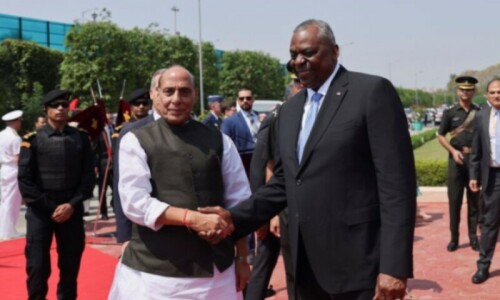
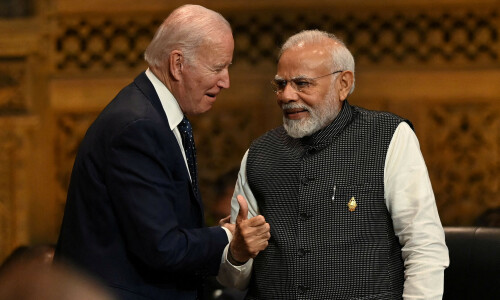
Indian Prime Minister Narendra Modi heads to the United States this week for a visit billed as a turning point for bilateral relations, with deeper cooperation in defence industry and sharing high technology in sharp focus.
According to Indian media reports, Modi is scheduled to land in New York tomorrow (Tuesday).
The visit is expected to give India access to critical American technologies Washington rarely shares with non-allies, strengthening a new bond that is underpinned by not just global politics but also business and economics.
Washington and New Delhi, whose relationship was marked by mutual suspicion during the Cold War, have been moving closer for over two decades now with successive US presidents displaying bipartisan support for stronger ties with the emerging Asian economy and regional power.
President Joe Biden has built on that legacy and expanded cooperation as the United States sees India as a vital partner in its efforts to push back against China’s expanding influence worldwide and strengthen security in the Indo-Pacific.
Washington also wants to wean India away from its traditional defence partner Russia. New Delhi continues to do business with Moscow and has increased its purchases of cheap Russian oil in the aftermath of the invasion of Ukraine, much to the frustration of the West.
India too has overcome its “hesitations of history” — as Modi put it in a 2016 address to US Congress — and looked West amid its own military tensions and fraying ties with China.
Though Modi has made several previous visits to the United States, this will be his first with the full diplomatic status of an official state visit, just the third of Biden’s presidency and third by any Indian leader.
“It’s a milestone in our relationship … It is a very significant visit, very important visit,” India’s Foreign Secretary Vinay Kwatra told reporters on Monday.
A key achievement expected to be showcased is in the area of defence cooperation, especially between military industries of the two countries, Kwatra said, as India seeks to produce more weapons and equipment at home for itself and also for export.
Jet engines, drones, semiconductors
Major announcements expected during Modi’s visit are US approval to General Electric to manufacture engines in India for its domestically produced fighter jets, India’s purchase of 31 armed MQ-9B SeaGuardian drones made by General Atomics worth $3 billion, and removal of US obstacles that prevent smoother trade in defence and high technology.
“People will be looking back on this visit by Prime Minister Modi as a real springboard for the US-India relationship, as it relates to defence … issues in particular,” Ely Ratner, Assistant Secretary of Defence for Indo-Pacific Affairs, said at a June 8 event.
A stronger India that can defend its own interests and can contribute to regional security is good for the United States, he said, adding that there is an aspiration to see India as an exporter of security in the region.
Cooperation in semiconductors, cyberspace, aerospace, strategic infrastructure and communication, commercial space projects, quantum computing and the use of artificial intelligence in industrial and defence fields, will also be discussed, a senior Indian official said.
During the three-day visit that begins in New York on June 21, Modi will be hosted by President Biden for a state dinner and a private family dinner, attend lunch with Vice-President Kamala Harris and Secretary of State Antony Blinken, and address a joint session of Congress for the second time in nine years.
Modi will also meet American CEOs and lead an International Yoga Day event at the UN headquarters.
“This is not a routine visit, this is a fundamental turning point between India and the US,” said C. Raja Mohan, senior fellow at the Asia Society Policy Institute in New Delhi.
“This is not a question of containing China or anti-China. This is about producing a new balance of power in Asia, which is a multipolar Asia, where there is no single power dominating it,” he said.