Under-threat UK balti restaurants keep calm and curry on

BIRMINGHAM: They gave their name to an area of Britain’s second city but Birmingham’s celebrated balti restaurants are facing a battle to survive.
The balti — a curry of spices, coriander, onions, tomatoes and green peppers with meat or fish — was created by Pakistani migrants in the mid-1970s to feed hungry customers from nearby pubs.
But after the heyday of the one-pot dish in the 1990s, when more than 30 restaurants could be found in the so-called “Balti Triangle” in the southeast of the city, today only a handful remain.
Andy Munro is on a mission to save what he and other devotees view as a key part of Birmingham’s cultural and culinary heritage.
Pakistani immigrants launched over 30 outlets in the 1990s, but now only a handful remain
On Ladypool Road — the “epicentre” of the “Balti Triangle” — Munro, 72, points out steak houses, burger joints and cake shops that have replaced former balti houses.
It’s a sign of changing tastes in food but also of the inner-city area of Sparkbrook, where the Irish pubs of old have closed and the population has diversified significantly.
“Most places didn’t own their own property — they rented it off landlords — and when balti became massively popular in the 1990s, I think landlords thought, ‘This is a golden ticket and I can put the rents up’,” Munro told AFP. “They were family businesses and they couldn’t afford to pay that.”
Restaurants also closed because the children of the first Pakistani immigrants to Birmingham did not want to go into the trade.
Popular
Zaf Hussain has bucked the trend, taking over Shababs, on Ladypool Road, which his father and brother ran before him.
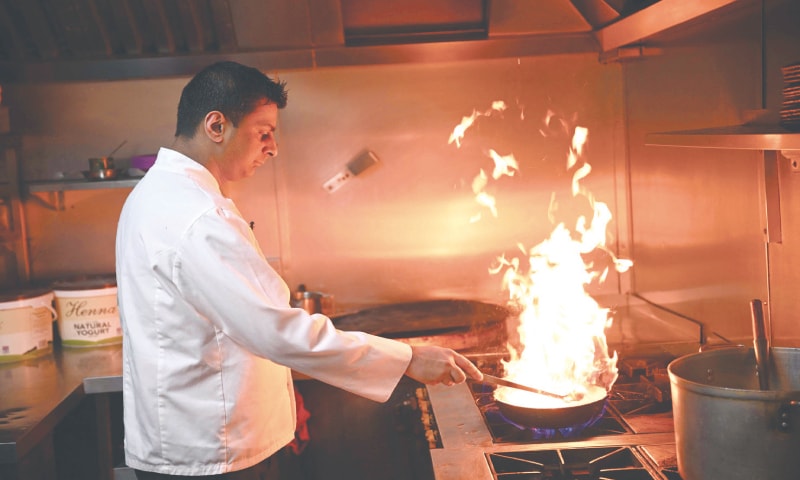
In his small kitchen, he passionately explains and shows how to cook a balti, deftly throwing oil, curry powder, coriander and other spices into a small steel dish with handles.
He adds pieces of chicken and a little stock, and a warm spicy aroma fills the kitchen. Just a few minutes later, it’s ready to eat.
Hussain first learned to cook baltis as a teenager and sees it as his duty to keep the tradition alive.
Shabaz Khan, son of the owner of another remaining restaurant, the Shahi Nan Kebab House on nearby Stratford Road, agreed.
“We have the responsibility of holding on to that tradition for as long as we can,” he said.
The goal, he added, was to “be able to serve something that would have tasted the same 60 years ago”.
“That’s the challenge,” he said.
In the restaurants, the clientele has changed over the years. There are now more families, who prefer to take their time eating.
Legacy
David Pariera, 38, has been eating baltis in the area since he was a child and calls them “the best [dish] in the world”.
“It’s a bit sad to learn that they’re closing,” he said, sitting at a table at Shababs, but insisted the balti houses were still popular.
“Come back on a Friday night. The weekend’s absolutely rammed,” he said.
The origin of the word “balti” remains contested but it could come from the Urdu word for “bucket” — a reference to the metal dish in which it is cooked and served.
The small, flat-bottomed metal bowls, made of pressed carbon steel with handles for stability on the gas stove, are made locally.
Balti champions have tried to get the dish European heritage status but their plans were scuppered by Brexit, Britain’s departure from the European Union.
Now Munro, author of “Going for a Balti: The Story of Birmingham’s Signature Dish” and who runs a website for balti lovers, is looking to the local authorities for support.
In the meantime, Hussain has big plans and work is already under way to expand his restaurant.
“I want to carry on this heritage. I want to carry this legacy forward for my family and for Birmingham,” he said.
“Even though the restaurants are in decline in the area, we are still going positive and looking on the up.”
Published in Dawn, June 19th, 2023